Another Artist for Posthumous Fame?
 On a fundamental level, I don’t understand art. Movies, as you unfortunately know, are something I can talk about all day. I can feel deep in my bones when they work, and my cringe factor will rocket off the charts when they don’t. Time, experience, and passion took me to a place where I understand movies.
Art is different. Don’t get me wrong, I like art. A day spent strolling through an art museum or checking out a gallery is a good day. But let’s say we’re standing in front of Banksy’s “Flower Thrower,” or Jackson Pollock’s “Number 1 (Lavender Mist)”, or Belkis Ayon’s “La Sentencia.” You say to me, “What do you think?” Best case scenario, I’ll tell you I like it or don’t like it. I don’t have the vocabulary or understanding to talk about art even semi-intelligently. At least, not yet.
That ignorance also means I can’t tell you if someone is or should have been a great artist. That’s the conundrum I was faced with watching Make Me Famous. It’s a documentary somewhat about New York City’s art scene in the 1980s, the one that birthed the careers of Jean-Michel Basquiat, Kenny Scharf, Julian Schnabel, and David Salle. Even I’m familiar with those names. I know they’re heavy hitters, but I had no idea Ed Brezinski was one of their peers. Oh, you’ve never heard of Edward Brezinski? Don’t worry, this documentary will fix that.
Through interviews, primitive home video shot at the time, and clever animated sequences, we first learn about the beginnings of Brezinski’s career. We see the tenement Brezinski lived in at Manhattan’s Lower East Side. It was directly across the street from a men’s shelter, and multiple interviewees remark upon stepping over passed-out bodies. From there, we enter his apartment. He converted it into a gallery, then called it The Magic Gallery, which artist Peter McGough called, “The most stupid name imaginable.”
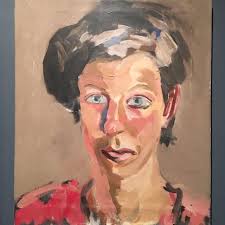 A few things become clear about who Ed is. First, he’s talented. We learn he’s an excellent example of a neo-expressionist painter* and his contemporaries remark upon his skill. He also had a habit of painting people he knew, then destroying the image in a fit of pique. Is he the kind of talented that means he should be a star, one of the greats? Some say yes, others no. Ed, however, thinks he deserves to be on top.
The second thing we learn about Ed is that his ambition burns bright. At every gallery showing, whether it’s his own or someone else’s, Ed is there hustling for attention. He understands that in 1980s New York, much like now, attention is the coin of the realm. Talent isn’t enough, and we learn about an infamous incident that took place at a Robert Gober exhibition. One of Gober’s pieces was a presentation of a bag of doughnuts.** Ed, in a fit of high dudgeon, grabbed one of the doughnuts and ostentatiously ate it. Unfortunately, it had been treated with formaldehyde. A trip to the emergency room, where he was told he was fine, turned into a phone call with the New York Post. For a moment, Ed was famous.
That brings us to the third thing we learn about Ed, which is that he’s an immense pain in the ass. Part of the problem is that he’s not a fun drunk, or a sentimental drunk. He’s a sloppy drunk. Ed tries hard not to be one. Instead he goes for the image of a sophisticate and in this post-punk scene he stands out by wearing natty suits. It doesn’t work. The booze gets its claws into him, and it never, ever lets him go. He also has a habit of getting into fights, of the physical, emotional, and romantic variety. Most of the time he loses.
 Ed’s fame faded, along with his career and his life in New York. Europe beckoned to him, or at least it appeared that way. His time in Berlin was spent in grinding poverty. He drank and got his ass kicked with depressing regularity. From there, he moved to France, where he died in Cannes in 2007. Was it the alcohol that killed him, or the physical abuse he seemed to seek out? Probably, but I think his life killed him. That’s not to say that he killed himself. It seems that once he believed he’d never be a famous painter, there was nothing else for him.
From there, director Brian Vincent and writer/producer Heather Spore enter the film. We follow them as they navigate France’s tangled bureaucracy to determine if Ed is really dead.*** We also watch them attempt to raise Ed’s artistic profile. It isn’t easy. Watch the scene where Ed’s cousin Ted says, “I don’t know how Edward could possibly be considered significant or important enough to warrant this type of inquiry into his past.” It all raises questions about talent and legacy.
I know, all of that sounds extremely heavy! It is, but under Brian Vincent’s direction, the film moves fast and is often very funny. He leads us through the 80s, the AIDS epidemic, the rise and fall of Reagan, and the rise and fall of Ed. Considering how much historical and psychological ground Vincent covers, I never felt like the pacing dragged. Along with that, it’s cleverly edited so that we can almost feel what it was like. During the scenes in Ed’s hovel of an apartment, I could almost smell the cheap wine and feel the drafts gusting inside. In a strange way, it often feels like a celebration of Ed’s life and times.
 I have no idea if there should be a reappraisal of Edward Brezinski’s work. Nor do I have any idea if he was a good painter, wildly underappreciated, or overrated. But he made an impact. His life and work mattered, and should be understood. Make Me Famous goes a long way towards doing exactly that, and it does so with skill and humor.
*If you’re like me and the phrase “neo-expressionist” is meaningless to you, this Wikipedia article was helpful.
**I learned that this particular art piece was sold for $240,000. To reiterate, I get art but I don’t get it.
***Spoiler alert, he’s definitely dead.