
Epic Outdoor Picture of the Day: Boulder Colorado in Black and White
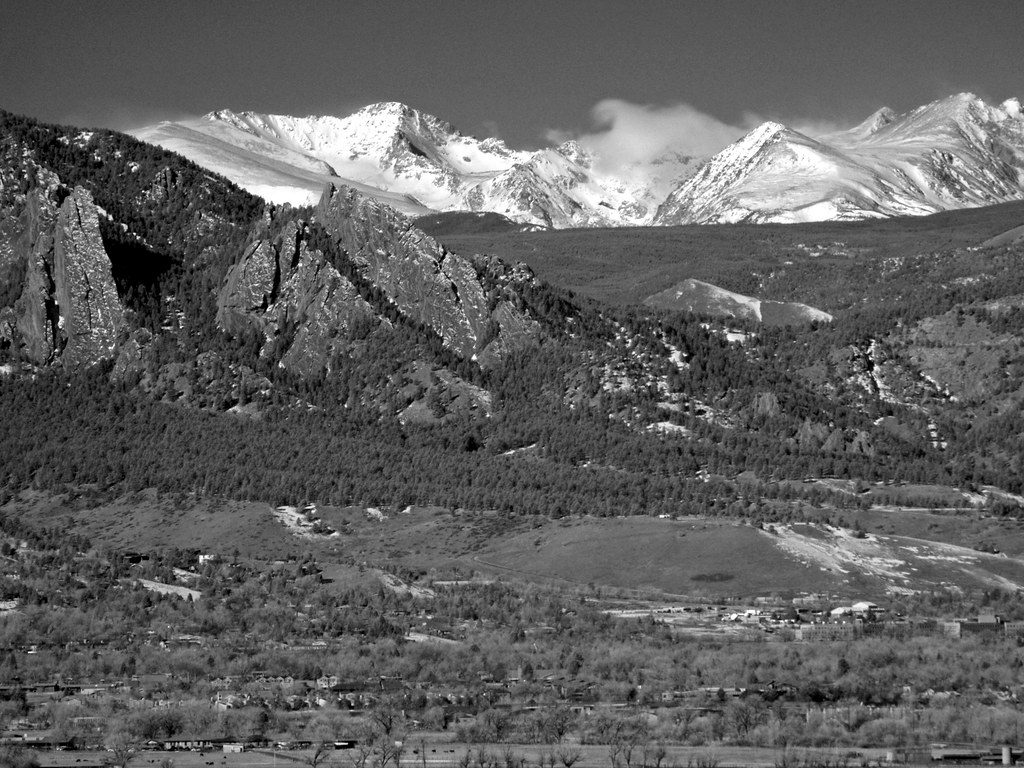
A Timeless View from East Boulder to the Continental Divide
Some photographs don’t just show a place — they reveal its soul. Today’s Epic Outdoor Picture of the Day does exactly that. Captured in striking black and white from East Boulder, this image stretches across the plains toward the dramatic silhouette of the Flatirons, rising boldly in the foreground, with the snow-capped peaks of the Indian Peaks dominating the horizon beyond. Without color, the contrast becomes the story: light against shadow, stone against sky, stillness against elevation.
The Flatirons appear sharp and commanding in this shot, their iconic sandstone slabs forming one of the most recognizable geological features in Colorado. These massive rock formations rise abruptly from the foothills, creating a natural gateway between Boulder and the high alpine world beyond. In black and white, their textures become even more pronounced — every ridge, crease, and face telling a story millions of years in the making.
Beyond the Flatirons, the eye is pulled westward to the distant, snow-covered summits of the Indian Peaks Wilderness. These mountains feel almost mythic in monochrome, standing tall as part of the Continental Divide. Many of the peaks here soar well above 13,000 feet, including Mount Audubon, North Arapaho Peak, and South Arapaho Peak. Their elevation is one of the reasons they look so dramatic from Boulder — they rise high enough to hold snow long after lower elevations have thawed, creating a year-round sense of alpine grandeur.
The Indian Peaks are especially significant because they sit directly along the Continental Divide, the invisible line that determines the direction water flows across the continent. Snowmelt from these peaks either travels west toward the Pacific Ocean or east toward the Atlantic. Standing in East Boulder, looking at this range, you are literally gazing at the backbone of North America — a geological boundary that has shaped ecosystems, weather patterns, and human history for centuries.
One of the most compelling aspects of this image is how it captures scale. From the wide-open plains of East Boulder to the rugged foothills and finally to the towering alpine peaks, the photograph compresses an entire geological journey into a single frame. The absence of color allows the viewer to focus on form and distance, making the mountains feel even larger and more powerful.
For those inspired to experience this landscape firsthand, the Indian Peaks are remarkably accessible from Boulder. A drive of roughly 45 minutes to an hour brings you to popular trailheads such as Brainard Lake Recreation Area or Fourth of July Trailhead near Nederland. From there, hikers can explore alpine lakes, high tundra, and panoramic views that mirror the majesty seen in today’s photograph.
Fun facts add even more depth to the scene. The Indian Peaks Wilderness spans over 76,000 acres and protects fragile alpine ecosystems that include pika, ptarmigan, and ancient bristlecone pines. Weather here can change in minutes, which is why snow can linger well into summer at higher elevations. These peaks also played a vital role in early exploration and continue to inspire photographers, climbers, and nature lovers from around the world.
This black-and-white image reminds us why Boulder is so special. Few places offer such a direct visual connection between town, foothills, and the Continental Divide. It is a reminder that beauty doesn’t always need color — sometimes, contrast is enough to tell the entire story.