I Prepare to Take a Bullet
Every day that us Boulder students go to school, we prepare—quietly—for the possibility of a bullet. That sentence should sound impossible. Instead, it sounds familiar.
I think I learned that familiarity long before I understood it. It started, for me, with a license plate.
The License Plate I Didn’t Understand Yet
When I was little, my mom drove me around Colorado in a car that wore one of the prettiest license plates I’d ever seen: a columbine flower floating in a blue-sky background, a soft lavender stripe, and two simple words stamped across the bottom, “Respect Life.”
To my little brain, it was just… pretty. A Colorado thing. Like seeing elk on road signs, or hearing adults talk about snowpack. I loved the colors. I loved that the plate felt special, like it meant we lived somewhere that paid attention to beauty.
Back then, I didn’t connect it to anything heavy. It wasn’t a symbol of grief in my mind. It was a decoration. It was state pride. It was my mom’s car.
As I got older, I learned what the plate actually was: a memorial. The “Respect Life” Columbine plate, made available in 2001, honors the thirteen students and staff killed in the Columbine High School shooting in 1999. And once you know that, you can’t unsee it. That plate isn’t just pretty, it’s a tiny traveling monument, multiplied across highways and parking lots, stitched into the background of everyday life in Colorado.
At a certain point, I started noticing how many of them there were. At stoplights. Outside grocery stores. In school pickup lines. It felt like the entire state was quietly carrying the same story, over and over, on metal rectangles bolted to bumpers. In 2023, there were 80,787 registered of this specialty plate (CPR), making it the most popular of Colorado’s specialty plates. That statistic landed in me like a strange contradiction: the plate is popular because people care, and because people remember. But it’s also popular because the event it memorializes has become a permanent feature of the place I call home.
After the shooting connected to Brown on Saturday, December 13, I’ve been thinking about gun violence the way you think about a song that you didn’t realize you knew by heart. One lyric starts, and suddenly the whole thing is in your body. I’ve been tracing the thread backward, back to that license plate. Back to being a kid, absorbing a symbol before I even understood what it symbolized. Before I knew why, gun violence had already entered my upbringing. It lived in the background. It shaped what felt “normal.” It taught my generation, quietly and early, that tragedy could be local, and that after tragedy, life would keep moving.
When Violence Becomes Geography
Now I’m 23, and my communities, like so many other communities, have been touched by mass shootings in ways that feel both specific and horrifyingly routine.
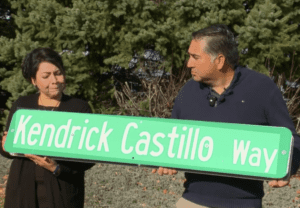
John and Maria Castillo holding a sign for the newly renamed Kendrick Castillo Way.
My mom works off Kendrick Castillo Way, previously named Lucent Boulevard. After the STEM School Highlands Ranch shooting in 2019, Douglas County renamed that busy stretch of road in honor of Kendrick Castillo (douglascounty.co), the 18-year-old who was shot and killed while protecting his classmates. The renaming is meaningful. It’s a way of saying: we saw him, we remember him, we want his courage to stay visible. But it’s also another example of how gun violence becomes geography. Streets become memorials. Directions to work become reminders.
Lockdown Normal
I was a sophomore in high school when Kendrick died. My school was a measly fifteen minutes away from STEM. On May 7, 2019, our building was locked down for the day. The memory is sensory: fluorescent lights, stiff chairs, the weird hush that falls over a hallway when adults are trying to keep a school calm. We sat in dark classrooms and looked down at our phones, refreshing, refreshing, refreshing, trying to piece together what was happening from fragments.
At that age, your brain holds contradictions without resolving them. I was preoccupied with an AP World exam, what I needed to study, what I hadn’t studied, and how much my score would matter. And at the same time, I was sitting in a locked classroom thinking, clearly and simply: school might not be safe. Not as a concept. Not as a distant news story. Safe like an in-the-building safe. Safe like can-I-go-home-and-hug-my-parents safe.
My best friend had an off period that day and was home. Later, she told me that students ran—actually ran—for their lives to her front yard, just a two-minute walk from STEM. When she described it, it made something in me go cold. Because “mass shooting” is a phrase you hear on the news, but “kids sprinting into your yard because they think they’re going to die” is a reality you can’t keep at a distance. It makes the whole thing immediate. It makes it your street. Your neighborhood. Your friends.
And then there was the other kind of fear—the kind that doesn’t even require gunshots to change your schedule.
One day, close to the anniversary of Columbine, Douglas County schools got two days off because of threats: a woman traveling to Colorado, reportedly intending to “emulate” the suffering of 1999 (PBS). I remember students celebrating the unexpected break like it was a snow day. The detachment was almost automatic. Not because we didn’t care, but because we didn’t know how to hold it. Because at sixteen, you don’t have a framework for mourning an event that hasn’t even happened yet. You just know school is canceled, and the adults are scared, and the reason is something you’re supposed to accept as part of the landscape.
That’s one of the strangest impacts of growing up with this: the way your nervous system learns to compartmentalize. The way you get good at swiveling between normal teen life and emergency protocols. The way “threats” become a kind of weather, something you check for, something you adapt to, something you complain about, something you learn to live under.
Boulder Wasn’t Immune
When I moved to Boulder, mass violence followed, because it follows all of us.
Ten people were killed while shopping for groceries at King Soopers (CNN). I remember the feeling of reading the headlines and picturing the most ordinary things: shopping carts, produce aisles, lists on phones, and realizing that even “errands” aren’t protected spaces.
Later, in other moments, the violence appeared in a different form: sudden, chaotic, fragmentary. Shots fired. Videos on Instagram. Things that spread fast because we’ve built a world where trauma travels at the speed of a swipe. I saw posts, then group chats, then the wave of “Are you okay?” messages that always follow. Another digital ritual. Another version of prayer.
There were days when fear went viral through campus apps and rumor chains. People spoke about a manifesto, about canceled classes, about staying inside. Whether every detail was accurate in the moment almost didn’t matter—because the feeling was real. The body doesn’t wait for verified information to go into alert. It hears “there was a shooting,” and it braces.
Even protests, spaces meant for collective voice, haven’t been safe. During a Pearl Street protest, a man set community members on fire, injuring eight (bouldercolorado.gov). I remember thinking: how is it possible that even when people gather to demand justice, the gathering itself becomes a site of harm?
This violence has followed me and my peers across our entire lives. From a pretty Columbine license plate, to lockdown drills, to school threats, to ambulances on Pearl Street. We’re tired. We’re desensitized in the way you become desensitized to anything your brain can’t survive feeling fully, all the time. We hear about mass shootings and continue our days. We learn to swallow it. We learn to say, “That’s horrible,” and then check our calendars. And part of that is coping. But part of that is also devastating: accepting this reality as our norm.
And still, nothing changes.
A Text We All Know
Through my work with Dream Tank, I’ve been collaborating with Brown students on an exciting Systems Change Lab, something built around care, clarity, agency, and the idea that young people can redesign systems that feel broken. We were in motion. We were planning. We were building toward possibility. And then, just days before launch, their community was struck by tragedy.
Again, the same pattern: a text. “There was a shooting.” “Is everyone safe?” Reading the same words on a small screen, over and over. Feeling detached from the horror even as I knew, intellectually, how bad it was, because detachment is how so many of us have learned to function.
I was with my friend at the time, a teacher in New York, when the news came in. We started talking about the systems, or the lack of systems, that are supposed to protect people in moments like this. And she said something that has stayed with me like a stone in my pocket:
“I tell my kids to hide, I prepare to take a bullet, and pray to God those kids stay quiet.”
It’s her first year of teaching. She’s 23—my age. And I hadn’t fully let myself imagine what it would feel like to be responsible for a classroom of children while also knowing you might have to coach them through the worst day of their lives. Not hypothetically. As part of the job.
That is not normal. That is not acceptable. That is not what “education” is supposed to mean.
We need change, not in the abstract, not as a vague hope, but as something real enough to reshape the daily lived experience of students, teachers, and families. We want to feel safe at school: the place where we learn how to think, how to disagree, and how to become citizens of the world. We want to spend our energy on learning, not on surviving.
And if my generation has learned anything from growing up under the shadow of Columbine, STEM, Boulder, and now tragedies in communities we love across the country, it’s this: remembrance isn’t enough. Memorials are not enough. Pretty plates that carry grief across the highway are not enough.
We can keep carrying the symbols, and we should. We should honor the people we’ve lost. But, we also have to insist on a future where those symbols don’t need to multiply. Where streets don’t have to be renamed. Where kids don’t have to practice hiding. Where the phrase “there was a shooting” doesn’t arrive like a routine notification.
We need to do better—for the students of today, and the students of tomorrow. And we need to mean it.
Stand with students, and for safety, NOW. Donate and share Dream Tank’s fundraiser. Follow Dream Tank on LinkedIn.