Mister Five Percent
 We can agree that the primary purpose of art is to elicit an emotional response, right? The way I understand it is, an artist creates their piece. That piece could be sculpture, painting, music, literature, film, or so much more. During the act of creation, they have an eye toward the hoped-for emotional response. A remembrance of things past, a feeling of connection to the larger universe, or the briefest instant of reconnection to a lost love. Stuff like that.
But what if, and I’m just spitballing here, you have an artist who only really cares about eliciting an emotional response in themselves? I’m not saying that’s a problem, yet I am saying that concept turns around the way we think about art. For example, I don’t think Tim Burton particularly cares what you, I, or anyone else thinks of his aesthetic. His art speaks to him, and as long as his movies make enough money to be profitable, he’ll keep making his movies the way he wants.* At its core, is that a problem? I don’t think so.
The same goes for Wes Anderson. He’s been making films since the middle of the 1990s. All of them low to mid-budget, and most of them modest hits. Once his films leave theaters, they’re buoyed by positive word of mouth and a long life on streaming and physical media.** As a result, Anderson has the means to keep making the movies he wants to make the way he wants to make them. That’s great news for him, with the release of his latest film, The Phoenician Scheme. Perhaps it’s less great news for me, when I feel like this film is a bit hollow, compared to his better work.
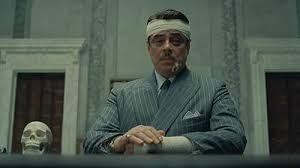
We’re introduced to industrial tycoon Zsa-zsa Korda (Benicio Del Toro) in the midst of his sixth plane crash. It’s not so much that he’s in a plane designed by Boeing, more that this is only the latest attempt on Zsa-zsa’s life. Assassination attempts have become predictable to him, to a tiresome degree. He’s even starting to recognize the various assassins.
Constant peril forces Zsa-zsa to consider his legacy in the long term, and to consider protecting his immense business holdings in the short term. He needs an heir. His nine sons won’t do, as they’re all too young, though you have to give Zsa-zsa credit. Several of them have been adopted on the off chance that one becomes the next Einstein. Zsa-zsa thinks of it as “playing the odds.”
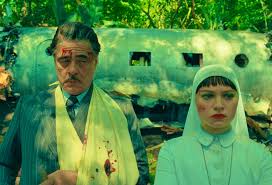 That leaves Zsa-zsa’s only daughter Liesl (Mia Threapleton), a young woman who’s making final preparations to become a nun. Is Liesl’s devotion to the Church so strong that she immediately rejects Zsa-zsa’s rampant greed? Not so much! Though I should mention that she’s not immediately tempted by vast amounts of money. Her interest is more in her father, and the possibility of reconnecting with him.
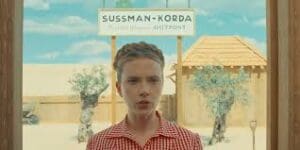
So Zsa-zsa and Liesl embark on an adventure. To learn the ins and outs of the family business, they negotiate a fiendishly complicated deal – one not involving slave labor this time around. To secure the funding, they’ll need to deal with two brothers (Tom Hanks and Bryan Cranston), a nervous prince (Riz Ahmed), a shady club owner (Mathieu Almaric), a clever American (Jeffrey Wright), Zsa-zsa’s cousin Hildy (Scarlett Johansson), and his Rasputin-like brother (Benedict Cumberbatch). It’ll be tricky, but at least Zsa-zsa and Liesl have secretive tutor Bjorn (Michael Cera) alongside them.
We all come to movies in our own time. I accept that, and accept that there are human beings walking the planet that have no idea who Steven Spielberg is. Having said that, pretty much everyone knows what a Wes Anderson movie is.*** The Phoenician Scheme is definitely, absolutely, one hundred percent at least a Wes Anderson movie. With his filmmaking, it feels like Anderson is doing three things with this film. The first is that he’s indulging his artistic side with the immaculate production design and precision-engineered cinematography/editing we’ve come to expect from him. As much as Anderson’s style careens dangerously close to parody sometimes, the fact remains that his filmmaking exists at a level that most filmmakers simply can’t match. Whether or not you like him, Anderson remains one of the greats.
 The second thing Anderson is after is his desire to make a goofy comedy, with the understanding that “goofy” means something very different to Anderson than it does to the rest of us. He and co-writer Roman Coppola have made a film that’s frequently funny. Understand that it’s not Anchorman funny or The Hangover funny. It’s more of a “funny in the style of a New Yorker editorial cartoon from 1973” funny. It’s not broad and it’s not the kind of thing that the whole family will guffaw at, yet I laughed loudly and frequently.
The third aspect is an examination of a wealthy man trying to learn What Really Matters. Anderson and Coppola’s screenplay occasionally digs into that with a few near death sequences, in which Zsa-zsa visits the afterlife (with Bill Murray as God, naturally!). It’s only occasional. Frequently, it feels like Coppola and Anderson say to themselves, “We could examine the concept of how money and corruption ruins a man’s soul…but we’d really rather have a sequence of middle-aged men playing basketball to determine the terms of a contract.” The themes and character aspects are not terribly deep. So much so that it often felt like the screenplay didn’t care about them.
This being a Wes Anderson production, you can expect performances that are highly specific and well done. The load is largely carried by Benicio Del Toro and Mia Threapleton, who appear in virtually every scene. I liked them both quite a bit, and both of them are doing the standard Anderson performance, in which they’re low key/damn near deadpan in reacting to absurd/highly emotional events. Despite that edict, the two of them share an enjoyable chemistry. Less enjoyable is Scarlett Johansson as Cousin Hilda. She’s a subtle actor who, when she’s given the chance, delivers enjoyably berserk performances. She’s not given the chance here, and the film suffers for it. More enjoyable is Michael Cera as Bjorn, who picks up the whole movie and steals it. For half or so of the movie, he’s playing a character who’s quietly and utterly bonkers. Once the truth about his character is revealed, he goes on to play a different kind of character who is equally bonkers. In nearly every Anderson film, there’s one performance that feels like the actor was briefly inhabited by an extra dimensional intelligence. For this film, it’s Cera.
 When Wes Anderson is seized by his cinematic muse, he must create art the only way he knows how. That means sometimes we’re treated to a specific kind of masterpiece, like The Grand Budapest Hotel or The Royal Tenenbaums. The Phoenician Scheme doesn’t measure up to either of those prior films, but I don’t think it matters. Anderson’s film is still made with a high degree of care and precision. He’s committed to his art as opposed to his audience, and if we want honest art, that’s the right way to go.
*I can’t imagine Burton being willing to work in franchise machinery.
**Anderson’s average budget is between $25-$35 million. That means his films don’t have to make that much to be profitable. The flip side is Mission: Impossible – The Final Reckoning, which had a total budget somewhere in the neighborhood of $400 million. It’ll have to make between $600-$800 million to simply break even. You can see the problem.
If Saturday Night Live can do a sketch mocking Anderson, which you can watch here, then he’s entered the public consciousness.