Necessary Trouble
 After Germany’s surrender in World War II, the Allied powers began a program of denazification. The plan was to fully remove elements of the Nazi party from Austrian and German society, and allow those countries to move forward in a positive, profitable, and presumably pro-American direction.* The process was expensive, time-consuming, and not entirely successful. But it was thought to be necessary to halt the rise of another Hitler.
A similar concept was attempted after the Civil War. It was known as Reconstruction,** and for a little while it worked like gangbusters before it utterly failed. Part of the reason why was the intense resistance against it by Southern states. Another reason was the ascension of Andrew Johnson to the presidency after the assassination of Lincoln. A confirmed white supremacist, Johnson had zero interest in protecting freed Black people, and went out of his way to pardon Confederates.
Could Reconstruction have worked? Maybe, but I know I’m not smart enough to get into the various pros and cons. What I do know is that the Civil War never ended. It escaped the nineteenth century, was reborn in the form of Jim Crow in the twentieth century, and is evolving into something else now. We still engage with it. We have no choice, and one of the more gimmicky and interesting examples of this is the documentary White Man Walking.
The white man walking in question is Rob Bliss. He made a name for himself by making goofy videos that occasionally went viral. One had the world’s longest water slide, and another had the biggest pillow fight. It was easy for Bliss to keep things light, until the summer of 2020 and the killing of George Floyd. Like many others for good or ill, the Floyd murder galvanized Bliss. He began by going to Harrison, Arkansas, a place Bliss refers to as “America’s most racist town.” There, he stood on the side of the street and in a parking lot holding a sign that read, “Black lives matter.” Then he waited to see what happened.
 Did people engage with him in a thoughtful and constructive manner, and hope to interrogate their own beliefs as much as they interrogated his? They did not. Along with the racist invective flung his way, he got a DM, which read in full, “Hey, dumbass, you should walk through Oakland wearing a White Lives Matter shirt and see what happens.” Yet on Instagram, DMs show an abbreviated preview of the message, which was, “Hey, dumbass, you should walk.”
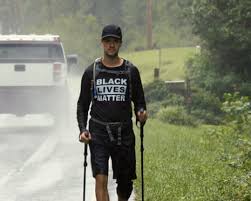
So Rob decides to walk. He begins in Jackson, Mississippi at the Mississippi Civil Rights Museum. The plan is to walk fifteen hundred miles to Black Lives Matter Plaza in Washington D.C., twenty five miles a day for sixty full days. All before the 2020 presidential election. A small crew follows Bliss to document the journey and, presumably, keep him from experiencing grievous bodily harm. As he walks, Bliss wears a Black Lives Matter shirt. On his backpack is a sign that reads, “Come Walk With Me.”
It takes fourteen days before anyone walks with Bliss. As you can imagine, it takes no time at all for people to give him the finger, try to run him off the road, and yell at him. Naturally, he encounters unapologetic racists. One man invites Bliss onto his property, only to threaten to kill him for trespassing moments later. From time to time, we hear voicemails from Bliss’ mother, who becomes increasingly worried for her son’s safety.
Bliss mentions his shock upon hearing people comfortable with dropping racial slurs. He says, “They say it so quickly, so easily, that it catches you off guard. It’s hard to believe that there are people who still hold such extreme views.” In some of those places, they never stopped holding those views. The common thread with these people is that they have no useful intelligence, no skills, and no charm. All they have is whiteness, and what they don’t know is that their whiteness is a tool that can destroy and cannot create.
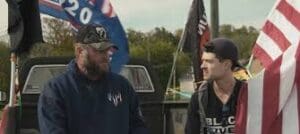
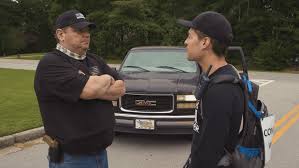
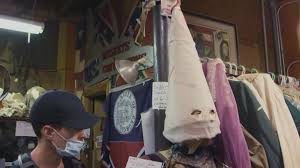 And yet, they’re an obnoxious minority. The majority of people Bliss encounters are different. A Black woman with Black Lives Matter thanks Bliss for his efforts, and agrees that if she were to do what he does, she would be killed. In Ohio, Bliss talks to a biracial woman who’s a passionate Trump supporter. The conversation ends not with threats or violence, but her hopes that Bliss is safe on his journey. In Louisville, Kentucky, Bliss asks a Black man for his advice regarding the walk. Without missing a beat, the man replies, “My advice to you is to get a cab or a bus.” Closer to the Capitol, Bliss chats with an enthusiastic Trump supporter, a White man with a pickup truck decked out in MAGA bumper stickers and flags. The two of them walk together. The man says, “We got to figure out how to get along.”.
There were multiple moments during White Man Walking where I thought, “I’m watching a snuff film, because this guy is going to get killed.” There are a few reasons why he doesn’t. The first is that pesky white privilege we’ve all heard so much about, and the second is the camera crew documenting Bliss’ movements. Mainly, Bliss is unfailingly polite and thoughtful to everyone he speaks with. From the knuckleheads flinging around the N-word to supporters cheering him on to the many, many people asking him if White lives truly do matter, Bliss engages with all of them. One man makes the white lives matter point, and Bliss observes that’s similar to showing up at a breast cancer fundraiser and reminding everyone that other diseases are important, too. Yet he’s never snide or condescending. He listens, makes arguments, disagrees without being disagreeable.
Bliss and his co-director, Denise Alder, have made a documentary that’s harrowing, thoughtful, and occasionally very funny. Remember about six thousand words ago when I mentioned this film is gimmicky? It is, preposterously so. During a conversation with Chanelle Helm, a Louisville, Kentucky BLM organizer, Helm says to Bliss, “What’s going to happen when you get to Washington? I’m hoping this walk gets you to understand that there is some bigger and more important work that’s going to hit you. I don’t know what that is for a White man.” While Bliss doesn’t argue, he has nothing to say to her. The argument could be made that the walk is nothing more than performative liberalism,*** and that it doesn’t actually make things better.
Only…it kind of does? The gimmick of Bliss walking was the point, and that’s not necessarily a bad thing. Bliss and Alder’s zippy film reminds us that, despite the insults and threats, most people want to get along – or at least engage with a degree of curiosity. It reminds us that the logo and concept of Black Lives Matter carries power. That power forces people within radically different bubbles to engage with one another. That’s a good thing, because once we stop talking entirely, we’ve lost.
 Black Lives Matter Plaza is gone now. It was removed in March of 2025 by the Trump Administration, at the urging of Representative Andrew Clyde of Georgia.**** That action did not bring us together, nor did it bridge an enormous gulf. This country, my country, is intensely divided. Still. More often than not, I have very little faith that the raw wound in our nation can be repaired. I think about taking my family and leaving entirely. Then I think about a friend’s smart observation. “Just when you’re plotting your escape, life reminds you that there’s still some hope around.” That hope can come in the form of a conversation, or a walk.
*With the exceptions of the countries controlled by Soviet Russia. Interestingly, the Soviets did a far better job implementing denazification. I assume that was because they simply killed or sent to a gulag anyone who refused to give up the Nazi ideology.
**For a detailed and thoughtful look at Reconstruction and how it echoes today, check out “How the South Won the Civil War” by the mighty Heather Cox Richardson.
***And as a liberal, I have to admit that liberals can be intensely annoying.
****Remember I mentioned performative liberalism? Clyde demanding the removal of Black Lives Matter Plaza is performative conservatism, in that his actions in no way improved the lives of anyone.