
Run, Glen Powell, Run!
 You might not be a fan of Arnold Schwarzenegger’s films. You might not be into his ludicrous musculature, his puns, or his movies that so often feature him shooting, stabbing, crushing, and exploding a wide variety of luckless goons. You might turn your back haughtily on all of that, but one thing you can’t do is deny that he’s made some all-timers. Conan the Barbarian. The Terminator. Predator. Total Recall. Terminator 2: Judgment Day. All bangers.
One of his films that is not a banger is 1987’s The Running Man. You have to understand that in 1987, I was a young punk of twelve. My expectations for movies were unbelievably low, and all I wanted from a Schwarzenegger movie was some cool action & to enjoy Arnold’s strange but undeniable charisma. There was no reason for me to not like this movie, and yet I did not like this movie. It looked cheap.* The action wasn’t dynamic. It was cheesy, and not in a good way.
The good news was that mediocre movie led me to its source material, a novella written by one Stephen King. Where the film was bright, colorful, and dumb, the novella is dark, brooding, and nihilistic. So much so that for years, I confidently thought nobody would ever adapt it properly, particularly with the infamous ending that essentially features a heroic 9/11. But if the last few years have taught me anything, it’s that the unexpected should be expected a good fifty percent of the time. Case in point is another adaptation of The Running Man, one designed to be more faithful to the source material and establish Glen Powell as an honest to goodness movie star. On both points, it mostly succeeds.
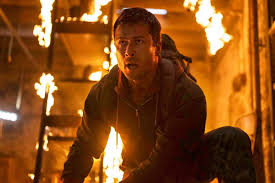
In the dark, not too distant future,** we’re introduced to Ben Richards (Glen Powell). In every way that matters, he’s in a bad place. His daughter is chronically ill, and Ben and his wife Sheila (Jayme Lawson) can’t afford the medicine she needs. Ben has been fired – again – due to issues with anger and insubordination. Sheila works a job that sounds either like sex work or is sex work adjacent. The apartment they live in is small, dingy, and depressing.
 Despite his seething rage, Ben has both a brain in his head and a strong moral code. He keeps getting fired because he stands up to bullies of the corporate kind. He’s got a lot of bullies to deal with, considering democracy has faded away and corporate oligarchy has taken its place. He’s a good man quickly running out of options.
One of Ben’s worst options is to audition for one of the many game shows on FreeVee, a network dedicated to programs that are violent, humiliating, stupid, or all of the above. The worst and most highly rated of them is “The Running Man.” Every season, three contestants are released into America, with a twelve hour head start. Their goal is to successfully evade their pursuers for thirty days, and the longer they’re uncaptured, the more money they make. The flip side is that citizens can rat them out for cash prizes. Even worse are the Hunters, led by the sadistic McCone (Lee Pace). They’re bloodthirsty, and good at finding their quarry.
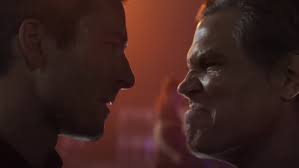
Ben promises his wife he won’t audition for “The Running Man,” then almost immediately breaks his promise. Executive producer Dan Killian (Josh Brolin), thinks Ben has what it takes to be the first real winner, and he likes Ben’s odds more than his fellow contestants, the hedonistic Laughlin (Katy O’Brian) and the clownish Jansky (Martin Herlihy). Egged on by the show’s slick host Bobby T (Colman Domingo), Ben will have to evade a squad of killers and a country full of narcs to save his family. All he can do is run.
In a way, Edgar Wright was a good choice to direct The Running Man. He’s one of the best in the business when it comes to creatively staged action sequences and clever editing. When Wright is cooking, such as a chase sequence in a fleabag motel or a siege within a booby trapped house involving Ben and a low-tech rebel played by Michael Cera, he creates some genuinely thrilling moments. As I watched the film, I kept thinking that it felt like an action movie from the 90s, such as The Rock or Speed. One of those films based around a ridiculous central premise that digs into the concept. Until we move into the third act, Wright does good work merging the silliness of the 1987 adaptation and the gloom of the novella.
 During that third act, though, things sputter out, and I think that’s due to an issue with the script written by Wright and Michael Bacall. There was no scenario where Glen Powell was going to crash a jet into the network’s high rise in the name of justice, and I maintain that as insane as the novella’s ending is, it’s maybe not the right ending. Bacall and Wright realized that, but the ending they cooked up doesn’t feel satisfying either. It’s as if the first two acts were frontloaded with dazzling creativity, and the two writers wheezed to get over the finish line. The other issue I kept thinking about was that the script isn’t angry enough. To be sure, there’s plenty of satire here about a stupid and violent show for a stupid and violent country. The problem is, the script isn’t truly mad about that. If you watch Paul Verhoeven’s RoboCop and Starship Troopers, you’ll experience screenplays that effectively mix mockery and venom. This script has a good helping of cleverness, but what it’s lacking is teeth.
The cast knew what they were signing up for, and there’s a galaxy of fun weirdos orbiting around the steady performance of Glen Powell. Of the aforementioned weirdos, I had a lot of fun with Michael Cera’s clever trap designer, Colman Domingo’s slick host, William H. Macy as an exhausted black marketer, and Daniel Ezra as the unlikely named Bradley Throckmorton, a quasi-YouTuber exposing the secrets of “The Running Man.” Josh Brolin’s Killian doesn’t show up too much, but he’s an oily and amusing foil. As for the Running Man himself, Glen Powell turns in a performance I could see Bruce Willis doing in the 90s. While Willis’ take likely would have been either smirkier or sadder, Powell pivots to the character’s righteous anger. He’s playing a guy who doesn’t want revenge, he just wants a fair shot for himself and his family. I liked hanging out with him, and it never feels like he’s struggling to carry the film. Though the film really, really wants to prove to you that Glen Powell is a movie star, I don’t know that movie stars exist in the traditional sense any longer, and I don’t think the film needs to work that hard to convince us that Powell is one of them.
 I wouldn’t call this adaptation of The Running Man a modern classic, nor would I call it a failure. What it is is simply a good time at the movies, and if you calibrate your expectations accordingly, I’m fairly sure you’ll enjoy it. For all its flaws, it’s a better film than the Schwarzenegger version. To put it all in context, if you showed this film to me in 1987 in the tiny Texas theater where I spent part of every summer, I would have lost my damn mind.
*It was directed by Paul Michael Glaser, who did most of his work directing TV. As much of a letdown as The Running Man was, he directed The Cutting Edge, a criminally forgotten rom-com.
**King’s novella takes place in 2025. Make of that what you will.