The Boulder Before Boulder
My grandma laughs when she describes the Boulder she arrived in.
There were things she and my grandpa Joe were used to buying back East: prosciutto, certain groceries, little luxuries that simply didn’t exist here. There weren’t many restaurants. The only place you could get liquor was outside the city, and if you brought it into town it had to be in a brown bag. Pearl Street had a hardware store. There were horse ranges not far from downtown.
They arrived at the end of December 1961 with two babies: my aunt Becky and my dad, Sean, who was two months old. Boulder still felt rural, a county built around mines and mountains, servicing the foothills and the people who worked them.
Growing up, I visited my grandparents in a house full of books, music, and art. My favorite thing was my grandma’s collection of figurines from different countries, tiny beautiful pieces that made her home feel connected to places I couldn’t yet name.
I’ve wanted for a long time to understand her more fully. Not just as the person who made spaghetti and kept shelves of novels, but as someone with a whole life before I arrived, someone who helped shape the city I now call home. So I sat with her and asked.
Finding a Classroom
Maggi was new to Boulder, home with two babies, playing a lot of bridge.
One evening, she and my grandpa Joe went to dinner at the home of an older couple on Mapleton Hill. My grandpa asked if they knew of a group Maggi could get involved with, something beyond the rhythm of life with young children. They pointed her toward the League of Women Voters.
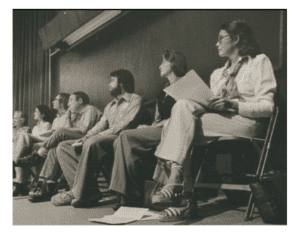
She started attending meetings without fully realizing she’d found a classroom. The room was filled with women like her: curious, well-educated, craving something bigger than the walls of the day. Her first meeting was on water: aquifers, water law, the hidden systems that decide what a place can become. “It felt like college,” she told me.
Over time the League stopped being something she attended and became something she led. By 1970 she was president, writing statements, giving speeches, showing up at city council and county commissioner meetings with research and a clear voice. Boulder was changing fast, and the League gave Maggi a front-row seat to all of it.
The Meeting that Made Her Run
In 1974, Maggi went to a county commissioners meeting where they were discussing development east of Boulder. A group came in urging the county not to approve the project. There wasn’t enough water. Everyone knew it. The commissioner approved it anyway.
People had shown up, spoken clearly, and been ignored. If that could happen on something as fundamental as water, what else could be brushed aside?
So she did the thing most people only talk about: she ran for county commissioner.
She wasn’t a newcomer anymore. She’d served on long-range planning, and she’d been thinking for years about what Boulder County needed: a real comprehensive plan, one that named plainly where development made sense and where land should be protected. The county was changing fast. Maggi thought the rules guiding that change had to catch up.
“Maggi Can Do It Better”
Her campaign looked like democracy at its best: buttons, t-shirts, handmade signs, conversations at kitchen tables and in community rooms.
The Daily Camera opposed her and supported her opponent, George, who she described as “nice enough,” but not what Boulder needed. People told her she should stay home with her children. Others insisted she wouldn’t understand “roads and bridges,” as if public leadership were a hardware manual only men could read.
The job, she could see, was planning. Judgment. Listening. Long-term decisions. She could see no reason a woman couldn’t do it.
Her opponent wore a button that said, “Let George do it.”
Maggi’s supporters responded with their own: “Maggi can do it better.”
She Won.
She won. Boulder County’s first woman commissioner. The League celebrated. Her friends celebrated. People who had been waiting for proof that the door was finally opening celebrated.
Maggi took office in January 1975, at a time when the women’s movement was rising, the “zero population growth” debate was alive, and anxiety about nuclear weapons sat like weather over daily life. Boulder was turning from red to blue. And now, so was who got to lead it.
The Work Itself
She took office in January 1975 and got to work.
Almost immediately, she helped push Boulder County toward what it’s now known for: protecting land and planning ahead. She helped establish the early open space program, identifying lands that should be protected, places like Walker Ranch. If you live in Boulder now, you can feel that impulse everywhere.
But the moments that stayed with her were smaller. Early in her tenure, she supported a senior citizen and disability housing program using federal grants. When the first building opened, she visited and talked to residents. One woman told her, plainly, that without this place she would be on the streets.
Maggi had voted to start that program. A decision made in a meeting room had become shelter, dignity, a life that looked different than it would have otherwise.
She also learned how wide the job actually was. She served on the health department and saw what public health really includes: water quality, septic systems, the quiet infrastructure of daily safety. And in a role people had reduced to “roads and bridges,” she pushed for equal pay for women doing equal work inside the county.
The Shadow of Rocky Flats
Rocky Flats sat ten miles from downtown Boulder, a nuclear weapons plant producing plutonium triggers, and for years most people tried not to think too hard about what that meant.
Maggi didn’t have that option. She served on state committees related to Rocky Flats for years, at a time when reliable information about nuclear risk was hard to find. Some of the clearest materials she could access came through the League of Women Voters.
Then came the fires. Blazes in 1969 and the mid-1970s released radioactive material into the air. Protesters gathered outside the gates. Maggi remembers details that still make your stomach drop: snipers pointed at the crowd, danger that felt everywhere and unspeakable.
In the early 1980s, FEMA officials came to a commissioners meeting with scenarios for “limited nuclear war.” They thought Boulder could be a target. The next morning, PBS asked Maggi to discuss it on The MacNeil/Lehrer Report.
Boulder as a nuclear target. Evacuation plans on a whiteboard. My grandma in a studio, answering questions with the steady tone she seems to use for everything.
What She Wants Us to Know
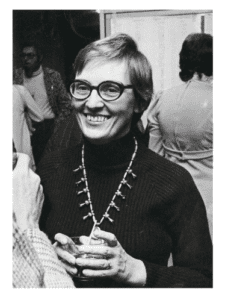
I kept coming back to that image: my grandma in a Denver studio, sitting across from FEMA officials, talking about what happens if the bombs fall. Not flinching. Just answering.
So I asked her what she hopes her grandchildren will understand about why she did any of it.
She told me not to be afraid to run for office.
Not because winning is the only form of impact, but because running is itself an act of public education. You speak. You write. You interview. You put ideas into the air. Even if you lose, you give people an alternative perspective they didn’t have before. And if you win, she said, you learn constantly, because people want to teach you. Forestry. Geology. Water. Policy. The real curriculum of a community, one you never find in a classroom.
What she was describing wasn’t ambition. It was a kind of courage that’s quieter and harder than ambition: the courage to walk into rooms where you weren’t expected, to ask questions you weren’t supposed to ask, to keep learning long after most people stop. My grandma did that. She walked into rooms full of men and didn’t shrink. She made decisions that were practical and she never once seemed to think that made her exceptional. That was the most extraordinary part.
I think that’s what she wants us to understand. Not she did something great, but that anyone can. That the distance between a citizen and a leader is shorter than we’ve been told.
So here is my challenge to Boulder: know your neighbors. Learn about our city. Ask the questions you think are too basic, too small, too late. Because the kind of place we want to live in doesn’t get built by a few exceptional people. It gets built by all of us, deciding, together, that we’re willing to show up.
The Inheritance
I’m headed to law school now, at CU, the same university that sits at the center of the city she helped shape. I’ll walk into rooms full of people who look like me, and some who don’t, and I’ll probably never think twice about whether I belong there. She thought twice. She walked in anyway.
That’s what I keep coming back to. The open space I run through on weekends, the growth debates that never really ended, the long shadow of Rocky Flats… all of it exists in its current form because people like my grandma showed up when showing up wasn’t guaranteed. She didn’t know she was building something I’d inherit. She was just doing the work.
Learning her history doesn’t only make me proud. It makes me feel responsible, in a way that’s grounded rather than abstract. Her leadership didn’t come from certainty that she belonged. It came from paying attention, learning fast, and deciding the work mattered more than the doubt.
She stepped into rooms that weren’t built for her and spoke as if her presence wasn’t a question, because to her, it wasn’t.
That’s the inheritance I want to carry forward. Not the title, not even the “first,” but the posture. Stay curious. Stay useful. And when something feels wrong, step closer instead of backing away.
The Boulder I love exists, in part, because my grandma refused to be polite about the future.