The Paper Man
 On November 11, 1947, Winston Churchill said during a speech, “Many forms of government have been tried, and will be tried in this world of sin and woe. No one pretends that democracy is perfect or all wise. Indeed, it has been said that democracy is the worst form of government except for all those other forms that have been tried from time to time.”
Churchill wasn’t wrong in his remarks about democracy, and I think the same concept could be accurately applied to capitalism. I know, some of you are going to unfurl your American flags and, with tears in your eyes, yell, “America has the greatest economic system in the world, and it’s not even close!” Before you start firing off Roman candles and scream-singing “The Star Spangled Banner,” I’ll remind you that any economic system that allows rich people to fire workers with impunity and doesn’t provide a meaningful safety net kind of sucks.*
The economic anxiety so many people feel toward capitalism naturally gets expressed through art, and that thematic soil is fertile. One of the best to do it is South Korea’s Park Chan-wook. If you’re familiar with his work, it’s likely due to his films Oldboy and Lady Vengeance. He’s just released the comedy/thriller No Other Choice, and it’s peak filmmaking paired with cruel relevancy.
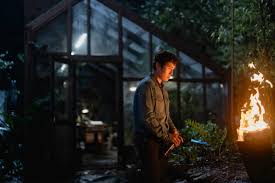
For twenty-five years, Man-su (Lee Byung-hun) has been a hard worker. He’s given nearly everything to Solar Paper, and his loyalty has not gone unnoticed. The paper company trusts his work and expertise, and in return he’s been handsomely compensated. That allowed him to buy his childhood home and fix it up, including a greenhouse for his beloved plants.
 As a result, Man-su has a good life. His wife Mi-ri (Son Ye-jin) isn’t with him because of the tennis lessons, the nice cars, the easy life. She loves him. He loves her. They have a teenage son who seems to be on a good path, and a young neurodivergent daughter who may be a cello prodigy. They have a good life.
Until they don’t. An American company buys out Solar Paper, and immediately begins a series of vicious layoffs. Man-su is one of the casualties, and his twenty-five years of service becomes just as irrelevant as he is. He tells his family what’s happened, and he vows that within three months, he’ll have another job in the paper industry.
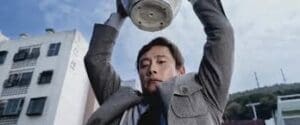
Thirteen months pass, and things have changed for the family. Man-su has an unsatisfying retail job. Mi-ri has gone back to work as a dental hygienist. Netflix has been cancelled. Cello lessons are in danger of being cancelled. The family dogs have been given to Mi-ri’s parents. Man-su is understandably desperate, and that desperation causes him to seize on an idea. He finds an open position at Moon Paper. What if he were to identify his competition? What if he were to create a fake paper company and set up a fake position? What if he were to lure the competition to apply for that fake position, and what if those applicants met with an accident, a fatal one?
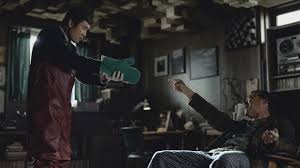 It’s long been said in the film industry that a good idea simply isn’t enough. The execution of that idea is what really matters, and No Other Choice is the perfect example of a great idea executed with precision and wit. Considering Park Chan-wook directed, I’m roughly zero percent surprised by that. He’s one of the best directors alive, and we see that in a scene about midway through the film. Watch the sequence where Man-su prepares to kill one of his targets. You see the picture where he’s wearing an oven mitt? That’s the one, and watch how Park uses blocking, editing, sound design with increasingly loud music, and controlled performances from three actors in concert. The end result is darkly hilarious, and I wonder if I’ll see another sequence that good in 2026. It’s more proof that Park has earned a spot in conversation with filmmakers like Spike Lee, Martin Scorsese and Christopher Nolan.
Park wrote the screenplay with Lee Kyoung-mi, Don McKellar, and Lee Ja-hye. Together, they’ve written a screenplay that’s viciously funny when it needs to be, and straight-up angry when it needs to be. It’s based on the 1997 Donald Westlake novel “The Ax,” and the sad irony is that even after bringing the story into present day South Korea, the core issue of thoughtless and unrestrained capitalism doesn’t change. Having said that, the screenplay never hectors the audience. It does masterful work of characterization, and we see Man-su as a man who believes in the system and hard work. We see what happens when the system fails him, and the lengths he’ll go not just for a great job, but for merely a decent job. Better yet, the screenplay is funny as hell, and there were multiple instances where I laughed in shock and appreciation.
You can imagine a worse version of this film, where Man-su is a character who is either mocked for his hard work or is a fundamentally upstanding citizen betrayed by his family and country. Lee Byung-hun turns in a smart and complex performance, which takes the film to another level. He absolutely plays a guy whose pride has been dented, someone whose entire identity circles around being an essential worker and dependable provider. While he mines comedy early on as a somewhat bumbling criminal, we see him learn and get better at it.*** But he’s not playing a gleeful sadist. He’s simply a man who knows the old order has fallen away, and new methods are necessary to hold onto what little he has. It’s a concept that’s just as brutally relevant in the United States as it is in South Korea.
 The sad irony of life in these United States comes in the form of a paradox. Many people vote as if they’re one lucky break away from becoming a millionaire, while the reality is that they’re one bad break away from homelessness, bankruptcy, or something far worse. When it comes to showing the horror and humor of capitalism, is No Other Choice a masterpiece? If it isn’t, it’ll do until a masterpiece comes along.
*You didn’t ask, but my preferred economic system is a mixed economy. According to Britannica, “Ireland has a mixed economy. The constitution provides that the state shall favour private initiative in industry and commerce, but the state may provide essential services and promote development projects in the absence of private initiatives.” In layman’s terms, that means Ireland’s economy is largely strong with a fairly good social safety net.**
**Except for the part where they have a housing crisis, which, um, we haven’t cracked either.
***In case you were thinking this was going to be a gentle comedy, I’ll remind you it was made by the same man who made Oldboy.