Walk On
 One of the most memorable first lines in the history of film can be found in The Godfather. It’s spoken by the coroner, Bonasera, who tells Don Vito Corleone, “I believe in America.” Bonasera talks of the brutal assault against his daughter. He explains to the Don that he went to the police and reported the assailants. In the end, the American justice system suspended the sentence of the attackers. Bonasera’s fundamental faith in America is shaken. So much so he asks Corleone to deliver real justice.
I get where Bonasera is coming from. As I write this, comedian Jimmy Kimmel may have had his talk show cancelled due to pressure from the Trump Administration. A conservative commentator was assassinated in full view of hundreds. So-called Christians cheer on performative cruelty. Large swaths of the country are at each other’s throats, and nobody seems particularly interested in talking or understanding one another. If you ask me right this moment, do I believe in America? If I’m being honest, it ain’t looking good.
Just like there’s a history in America of service and selflessness, there’s also a history of stupidity and brutality. Will it get worse? I suppose that depends on what your definition of “worse” is. Could it get as bad as the events depicted in The Long Walk, the new cinematic adaptation of Stephen King’s first novel? At this point, anything is possible.
We’re introduced to a fully dystopian America, one where another civil war tore the country apart. That was nineteen years ago, and in an attempt to inspire patriotism and boost the national work ethic, a sporting event was created. We have no idea if it’s wildly popular, or if it exists due to the whims of a perverse and tiny ruling class. We only know that the Long Walk takes place annually.
What are the rules of the Long Walk? Fifty young men, one from each state, are chosen through a volunteer lottery. Though it bears mentioning that the economy is in such disrepair, volunteering feels compulsory. Each contestant is given plenty of water and rations. They gather at a starting point. After an inspirational speech, The Major (Mark Hamill) fires his starter pistol, and everyone begins to walk.
 They must walk at a minimum speed of three miles per hour, and the walkers are accompanied by an armed military escort. The walkers cannot stop, not for sleep, not for a toilet break. If they do, they are given a warning and ten seconds to start walking again. After three warnings, a walker will “have their ticket punched,” or be summarily executed. If they try to run, they’ll be killed. If they beg for mercy, cry for their mothers, and all of those things will happen, they’ll be killed. They all walk until there’s one walker left, and that walker will receive a fabulous amount of money and have one wish granted.
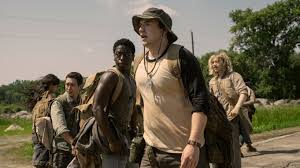
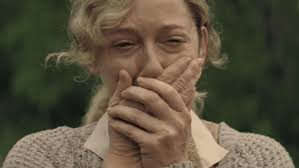
We meet Garraty (Cooper Hoffman), a sensitive and intelligent young man, who has a wrenching farewell with his mother Ginnie (Judy Greer). We meet DeVries (David Jonsson), who uses his optimism as a weapon against an unjust regime. We meet quiet and friendly Baker (Tut Nyuot), the fiercely competitive Stebbins (Garrett Wareing), motormouth Olson (Ben Wang), and the combative Barkovitch (Charlie Plummer). They all have their reasons for participating. Some will become friends. One will survive. All will walk.
If you asked me in the most general terms to explain what happens in The Long Walk, I’d tell you that the group walks awhile, we have some character development, a person stops walking and dies horrifically, wash, rinse, repeat. On its face, it sounds simultaneously boring and exploitative, and to pull it off properly, you’d need a good director. Luckily, Francis Lawrence, the filmmaker behind Constantine and a number of films in The Hunger Games franchise, took the wheel. Lawrence understands that two things need to happen for the premise to work. The first is that space needs to exist to get to know enough of the walkers. Lawrence provides that space and shows us who these young men are, and what they want. That causes us to care about them, and it means that each death has an impact. Secondly, Lawrence does outstanding work with ratcheting up the tension. He knows just how to pace things when a walker has a charley horse, a gastrointestinal problem, or a shoe that decides it wants to start coming apart. That leads to a soldier barking out a warning, then panic, then a cinematic death that looks unsettlingly like the real thing. He’s effectively assisted by cinematographer Jo Willems, who shoots them trudging through rural landscapes and depressed towns, which creates an effective atmosphere of social decay. These people live in a country that can’t function and seems to have given up.
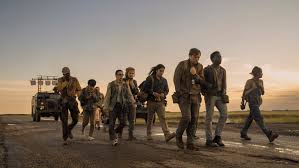 I was also impressed by the screenplay, written by JT Mollner, and it pulls off a tricky balancing act. I initially thought that it would be a non-stop bummer. Not exactly shocking considering it’s set in a world where state-sponsored murder is used as a motivational tool. Mollner gives us just enough information to make things plausible. He contrasts that with excellent character work and some genuinely touching friendships. The script is an apt reminder that even in the worst times and places, there are still an awful lot of good people.
With a single exception that we’ll talk about momentarily, the acting is uniformly naturalistic. If there’s a lead, it’s Cooper Hoffman as Garraty. He does strong work as a young man with his own motivations for walking, yet he doesn’t view the other Walkers as competitors. Charlie Plummer’s performance as Barkovitch is interesting, and he takes the sadist from the novel and transforms him into a lonely young man who runs on spite and yearns for companionship. I also liked Ben Wang very much as Olson, and his constant wisecracks provide necessary comic relief. Judy Greer only appears in a few scenes, but she’s absolutely shattering. If there’s a first among equals in the cast, it’s David Jonsson as McVries. He’s playing someone who uses his considerable trauma to do good, and he’s a walking middle finger toward the world he lives in. Jonsson is charming, focused, three-dimensional, and always magnetic.
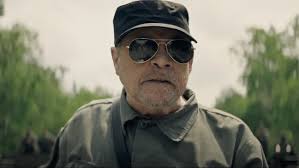
That single exception I mentioned? That would be Mark Hamill as The Major. It’s not a bad performance, though it is a big and broad one. For a while, I thought to myself, “Weird, he feels like he’s in another movie.” A little later, I started to wonder. Consider that we currently have a President with a public persona that’s so big, it makes him feel like a cartoon character. A little historical analysis tells us that’s not uncommon. There have been presidents, prime ministers, and kings who have cultivated a certain kind of image, one that’s radically different from who they are in private. It could be that The Major is meant to be one of those men, and they’re almost always men. He also might be cognizant that the Long Walk is televised, and he’s performing for an audience. Hamill is a smart actor, one who understands that performances need to be calibrated to match the tone of the movies they appear in. If they aren’t, either a serious mistake has been made, or that discordant performance is meant to say something. Is it possible that between Hamill, Mollner, and Lawrence, a risky decision was made? It seems that way to me.
 Our President announced that there will be a UFC match held on the South Lawn of the White House next year.* Hearing things like that makes me wonder if I believe in America. I don’t know if this country is in a partisan death spiral or, to paraphrase the historian Heather Cox Richardson, if we’ll pull out of it and bond to one another stronger than ever. I do know that I, for the most part, believe in people. Perhaps most of all, I believe in movies. The Long Walk is a good movie. Maybe not one of the best of the year, but it has fearsome power, and it balances that with unflinching humanity.