
Why Boulder Gets Some of the Strongest Winds in Colorado
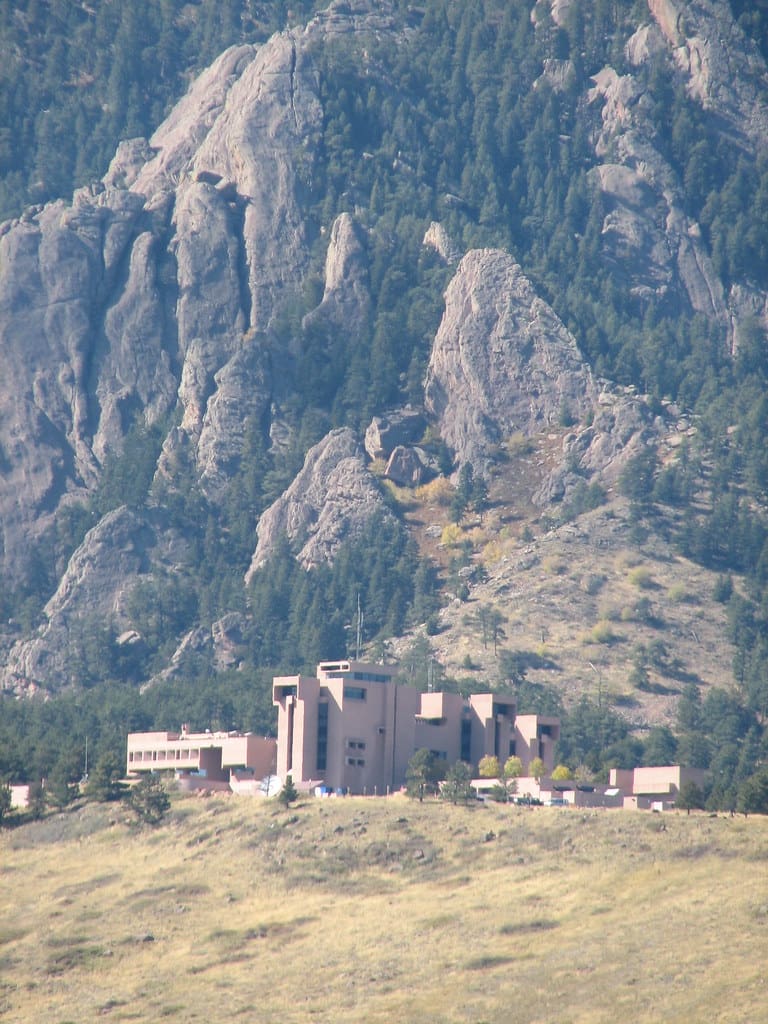
NCAR Building, Flatirons, Boulder CO
Boulder has a long-standing reputation for powerful, sometimes relentless wind. From sudden gusts that race through neighborhoods to sustained wind events that disrupt daily life, these conditions are not unusual here—and they’re not accidental. Boulder’s wind patterns are the result of geography, elevation, and atmospheric dynamics that consistently combine to make the city one of the windiest places along Colorado’s Front Range.
Boulder’s Geography Creates a Natural Wind Accelerator
Boulder sits at a critical transition zone between the Rocky Mountains and the open plains. Just west of the city, the terrain rises sharply toward the Continental Divide. When prevailing winds move from west to east across the mountains, air is forced upward and then pulled downhill by gravity as it descends toward lower elevations.
As this air drops, it accelerates. This downslope movement is one of the primary reasons Boulder frequently experiences stronger winds than nearby cities. Areas farther east may feel breezy, while Boulder contends with sustained high winds and sudden gusts that feel significantly more intense.
How the Foothills and the Flatirons Shape Wind Behavior
Boulder’s foothills and iconic rock formations play a major role in how wind behaves once it reaches the city. Uneven terrain compresses and redirects airflow, increasing speed and turbulence. Rather than flowing smoothly, wind is forced through natural corridors, ridges, and gaps.
This terrain-driven compression explains why Boulder winds often arrive in powerful bursts instead of steady streams. Gusts can appear suddenly, intensify quickly, and vary dramatically from one area of town to another.
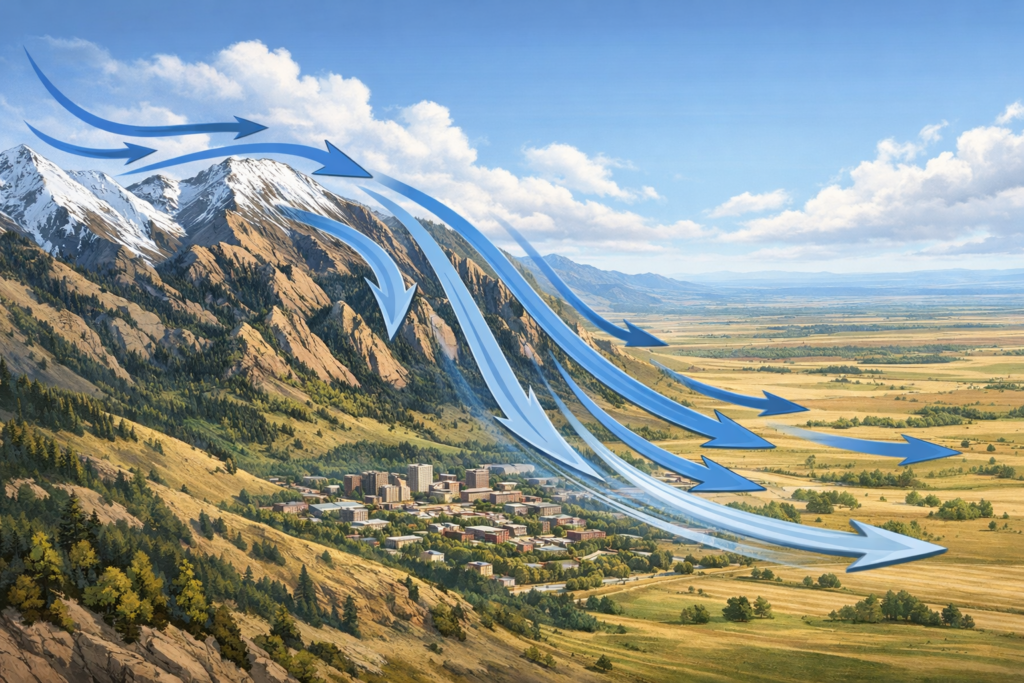
Boulder’s location at the edge of the Rocky Mountains creates a natural wind accelerator, where air flows over the peaks, descends rapidly through the foothills, and intensifies as it moves toward the plains.
Chinook Winds and Downslope Flow
One of the most influential weather patterns affecting Boulder is the Chinook wind. Chinooks form when moist air rises over the mountains, sheds moisture, and then descends rapidly on the eastern side. As the air sinks, it warms and accelerates, sometimes reaching extreme speeds.
These downslope winds are most common in fall and winter and are known for:
- Rapid temperature changes
- Very low humidity
- Increased fire danger
- Greater risk of infrastructure strain and power outages
Chinook winds are a defining feature of Boulder’s climate and a major contributor to its strongest wind events.
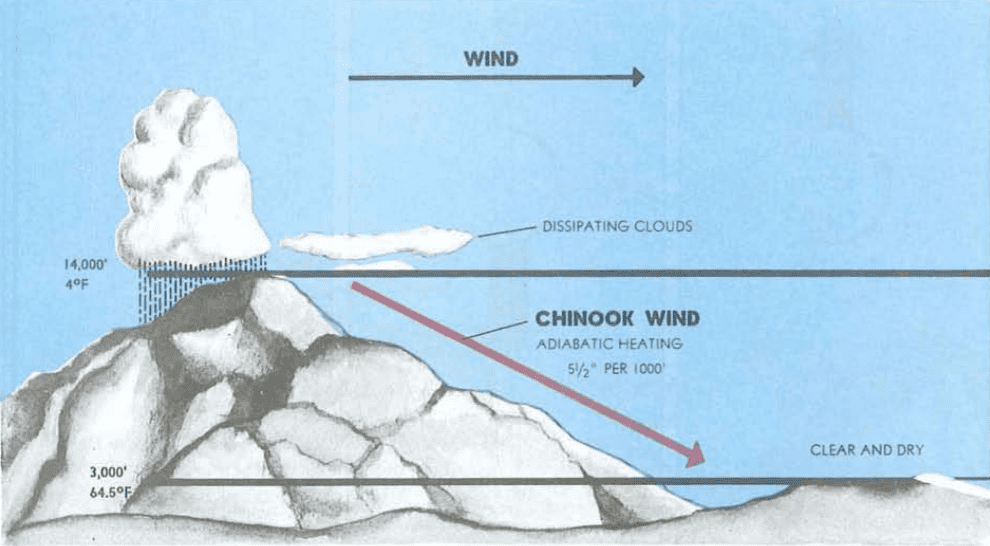
Why Wind Speeds Can Increase So Quickly
Boulder’s wind events are often marked by sudden spikes in speed. This is frequently caused by mountain wave activity. As air flows over the Rockies, it can form invisible waves in the atmosphere. When those waves break near the foothills, high-speed air is pushed sharply downward.
This process can cause wind speeds to jump dramatically in a short period of time, particularly in exposed areas near mesas, ridgelines, and open space. It’s one reason Boulder regularly records some of the highest gusts in the region.
Why Wind Impacts Vary Across Boulder
Not all parts of Boulder experience wind the same way. Neighborhoods closer to the foothills or at higher elevations tend to be more exposed. Open areas with fewer wind breaks often see stronger and more sustained gusts, while other sections of town may feel comparatively calmer.
This uneven distribution is a hallmark of Boulder wind events and a direct result of how the city’s layout interacts with surrounding terrain.
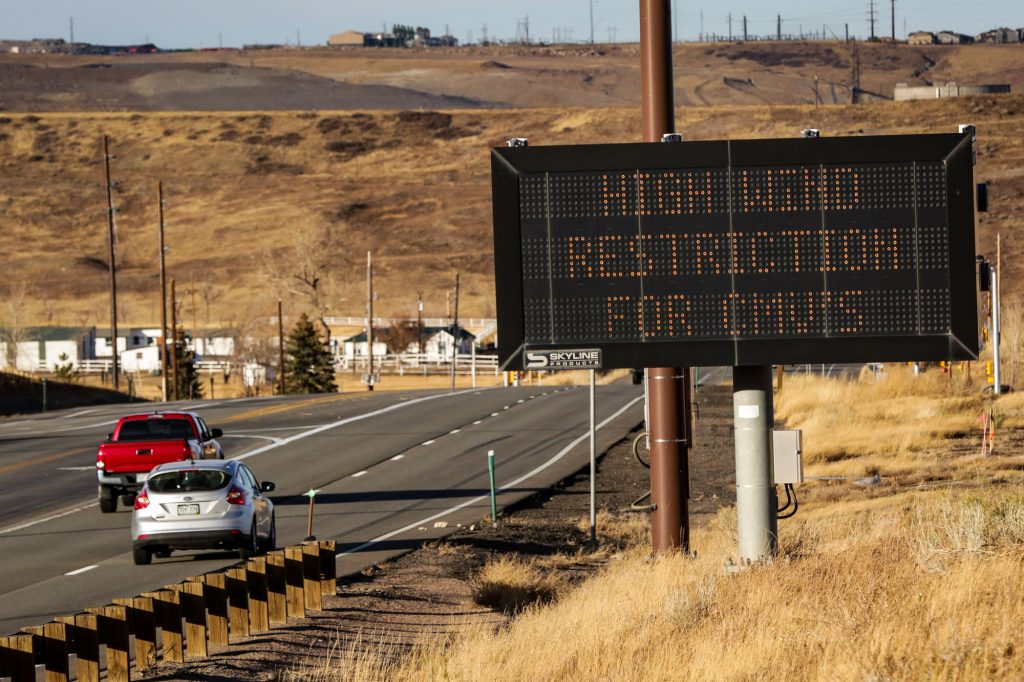
A sign warns motorists of high winds and hazardous travel on Hwy. 93 near Rocky Flats on Wednesday, Dec. 15, 2021.
Is This Typical for Boulder?
Yes. Strong wind events are a normal and recurring part of Boulder’s climate, especially during seasonal transitions. While conditions vary year to year, Boulder’s location ensures that high-wind episodes will continue to be a defining characteristic of life along the Front Range.
What often stands out is not just the wind itself, but its intensity, variability, and ability to impact daily routines—from outdoor recreation to power reliability.
Living With Wind in Boulder
Understanding why Boulder gets such strong winds helps explain why preparation is important. Securing loose outdoor items, planning activities with wind exposure in mind, and staying aware of weather advisories are practical steps for residents.
Boulder’s winds are a reminder of the powerful forces at work where mountains meet plains. They are as much a part of the city’s identity as its trails, peaks, and open spaces—sometimes challenging, often dramatic, and always shaped by the landscape itself.