
Wolves Are Getting Closer to Boulder: What Residents Actually Need to Know

Aerial Photography In Boulder, Colorado
Recent updates from Colorado Parks and Wildlife have caught the attention of Boulder residents. Tracking maps now show that collared wolves have explored watersheds in central Boulder County and nearby Jefferson County. While none have crossed I-25 or entered urban Boulder, their movement toward the Front Range is raising important questions.
What does this actually mean for your hikes, your pets, and daily life in the foothills?
The Current Situation
Right now, most wolves in Colorado remain in their established territories farther west, especially during denning season. The wolves pushing east are typically lone animals exploring new terrain, not full packs relocating.
It’s important to understand what the tracking maps actually show. A shaded watershed does not mean wolves live there. It simply means a collared wolf passed through that area at some point during the month.
Recent data suggests activity has slightly pulled back from the furthest eastern points reached earlier. Still, the overall trend is clear: wolves are expanding their range, and Boulder’s surrounding open spaces are now part of that broader picture.
How to Tell a Wolf from a Coyote
Boulder already has a strong coyote presence, so knowing the difference is important.
Size
Wolves are significantly larger. A gray wolf stands about 26 to 32 inches at the shoulder and can weigh 70 to 115 pounds. Coyotes are much smaller, usually between 20 and 50 pounds, with a slimmer build.
Tracks
Wolf tracks are large and distinct, about 4 to 5 inches long, roughly the size of an adult human palm. Coyote tracks are smaller, typically 2 to 3 inches.
Sound
Wolves produce deep, long, smooth howls that can carry for miles. Coyotes sound higher-pitched and more scattered, with yips and quick bursts.
Appearance
Wolves have broader heads, thicker bodies, and shorter, bushier tails. Coyotes appear more fox-like with narrow muzzles and pointed ears.
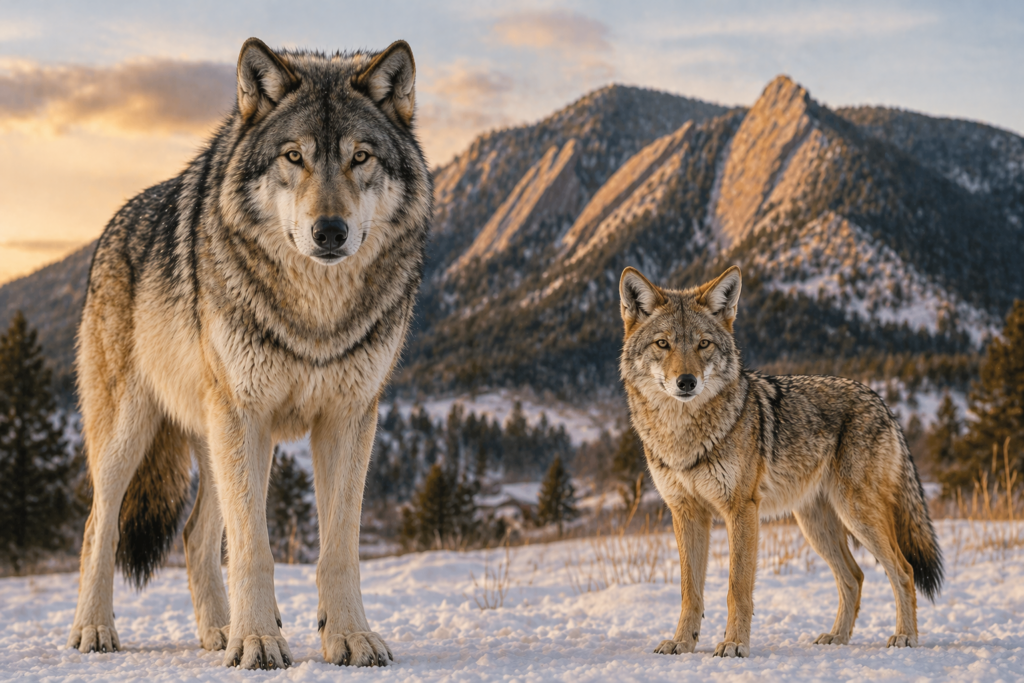
A gray wolf (left) and a coyote (right) stand side by side in a snowy Boulder landscape at golden hour, clearly illustrating the striking differences in size, build, and presence between these two iconic Colorado canids.
Practical Tips for Boulder Residents
Encounters with wolves remain rare, but a few simple habits go a long way.
Keep dogs leashed
Especially during early morning and evening hours when wildlife is most active.
Supervise pets
Avoid leaving small pets alone outdoors in foothills neighborhoods.
Give wildlife space
If you see a wolf, do not approach. Keep your distance and stay calm.
Make your presence known
Talking or making light noise while hiking helps prevent surprise encounters.
Secure attractants
Trash, pet food, and unsecured items can draw in wildlife.
Wolves generally avoid humans. Respecting their space is the best way to avoid conflict.
The Bigger Picture
Colorado’s wolf reintroduction continues to generate conversation across the state. Some residents welcome the return of a native apex predator, while others are concerned about livestock and pets.
What’s happening now is gradual. Wolves are not flooding into Boulder. They are slowly exploring new terrain and expanding their range over time.
For Boulder residents, awareness matters far more than alarm.
What to Do If You Spot a Wolf
Seeing a wolf is rare, but it’s important to respond correctly.
Stay calm and do not run.
Back away slowly while facing the animal.
Keep pets close or pick them up if possible.
Make yourself appear larger if needed and maintain distance.
Afterward, report the sighting to Colorado Parks and Wildlife. Confirmed reports help improve tracking and understanding of wolf movement.
Living Alongside a Changing Landscape
Wolves remain uncommon near Boulder, but their presence is part of a changing wildlife landscape in Colorado.
The takeaway is simple. Stay informed. Stay aware. Respect wildlife.
Boulder’s open spaces have always been shared with nature. Now, that occasionally includes one of North America’s most iconic predators passing quietly through the foothills.