
Floral Park: Boulder’s Hidden Gem of Communal Architecture
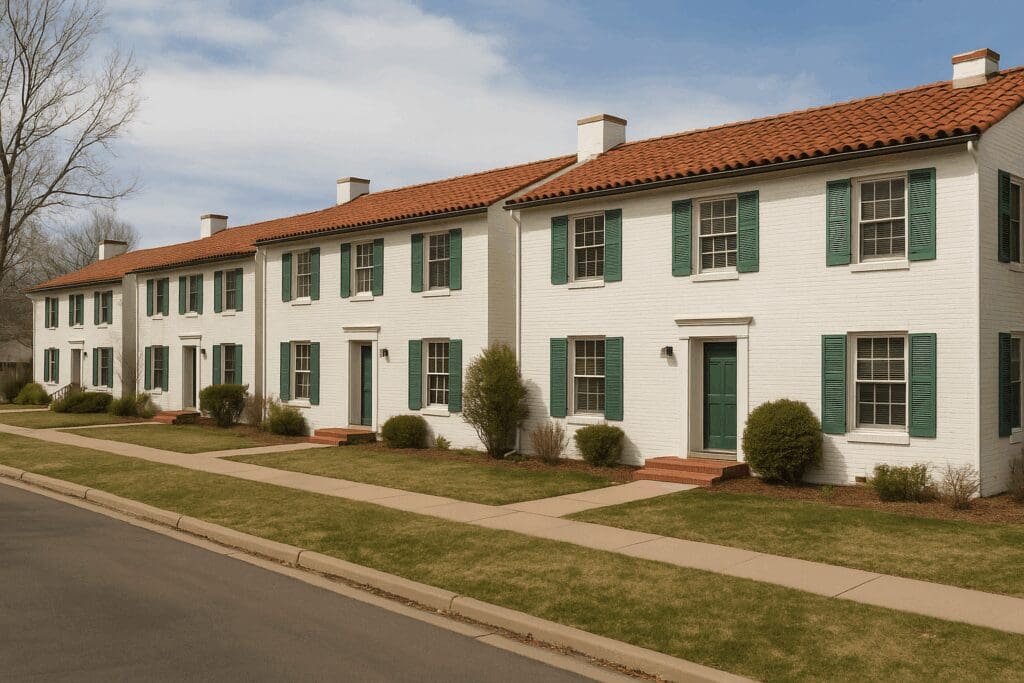
A realistic depiction of Boulder’s Floral Park Historic District, also known as “Little Russia.” These Monterey Colonial-style homes—built in 1939–40—feature white brick façades, red tile roofs, and green shutters, representing Boulder’s first planned-unit development and a timeless symbol of architectural unity and community spirit.
Discover Boulder’s Secret Neighborhood: The Story of Floral Park’s “Little Russia”
Tucked away near the University of Colorado campus lies one of Boulder’s best-kept architectural secrets—Floral Park Historic District, affectionately nicknamed “Little Russia.” Even longtime Boulderites are surprised to learn about this charming enclave of eight nearly identical homes that date back to the late 1930s. With white brick walls, red tile roofs, green shutters, and a shared garage, the neighborhood offers a rare glimpse into Boulder’s early experiments with communal living and design unity.
Built between 1939 and 1940 by a group of University of Colorado faculty members, Floral Park was Boulder’s first planned-unit development—a revolutionary idea at the time. These professors didn’t just want to live near campus; they wanted to build a community. They pooled resources, hired the same architect, and created a small village where the homes echoed one another in harmony and intention.
The style? Monterey Colonial, which blends Spanish Colonial and New England design influences. The architecture is modest but elegant: simple white façades, red barrel-tile roofs, multi-pane windows with green shutters, and an overall balance that reflects shared purpose. A single garage—designed for all eight homes—sits at the rear, reinforcing the idea of cooperation over excess.
Today, Floral Park stands as a quiet tribute to both Boulder’s architectural evolution and the idea that neighborhoods can be more than just a row of houses—they can reflect values, culture, and a spirit of unity. The district was officially added to the National Register of Historic Places, and walking through it feels like stepping back in time, yet somehow entirely in tune with Boulder’s progressive spirit.
Most of the homes have remained remarkably intact, with only minor updates made over the decades. In fact, their consistency is part of what earned the district its historical status. While many Boulder neighborhoods boast beautiful homes, Floral Park is unique for its cohesive vision—a nod to its communal roots.
For those interested in historic preservation, the City of Boulder Historic Preservation Program offers resources, walking tour maps, and additional information on this and other protected neighborhoods. You can also explore deeper historical documentation and photos through the National Park Service, which maintains detailed listings of Boulder’s architectural landmarks.
Why It Still Matters
In a city known for bold design—from Charles Haertling’s rock-integrated homes to canyon-edge villas—Floral Park stands out precisely because of its simplicity and shared vision. It’s a humble neighborhood, but its roots run deep. It reminds us that Boulder isn’t just a hub for innovation and outdoor adventure—it’s also a place that celebrates thoughtful planning, quiet beauty, and community.
If you’re walking near Mariposa Avenue or the CU campus, take a detour and stroll through this historic treasure. You might not find it on the average Boulder tour map, but that’s exactly what makes it so special.
To discover more local gems like Floral Park, check out the community highlights at this local site.