
Guilty Until Proven Innocent
 It’s been said that all art is political, even art that’s a bit stupid. Your slobs versus snobs comedy Ghostbusters? That’s about how a group of small business owners can more effectively deal with a crisis rather than the wicked EPA. Your dumb as toast disaster epic Armageddon? That’s about how in the face of…um…armageddon, American exceptionalism will save the day.
I see comments all the time from people begging filmmakers to strictly create movies that are entertainment and nothing more. I’m not sure that’s possible, and there are two reasons for that. The first is that, like it or not, artists live in the world. They’re affected by politics and opinions, and we see the end result in the art they create. Secondly, art is not commerce, bound by the whims of consumers. If you’re a viewer, and you’re upset that the MCU is woke or that there’s too much copaganda, tough break. Don’t watch, make something of your own.
I admire it when a film tries to engage with politics, particularly if it’s engaging with things that are causing anxiety. The new cyber-thriller Mercy attempts to tackle the rise of artificial intelligence, a fear of crime, and (accidentally) the willingness of citizens to trade their rights for something that feels like security. Does it work? Not so much, since it’s mostly surface-level as opposed to substance.
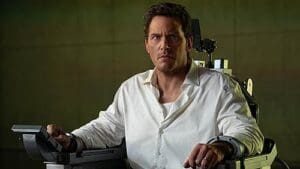
When we meet Detective Chris Raven (Chris Pratt), he’s having a very bad morning. The first thing he realizes is that he’s dealing with a massive hangover. That’s a problem since he’s an alcoholic, and he realizes that he’s fallen quite severely off the wagon. So much so that perhaps there’s no getting back on.
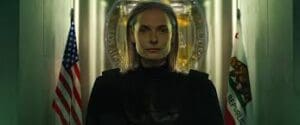 The second thing Raven realizes is that he’s strapped to a chair. Before him are a series of shifting holographic screens, and he sees the crisply professional face of Judge Maddox (Rebecca Ferguson). She bids Raven a good morning and informs him that he’s the eighteenth person involved in the Mercy program.
What is that? Due to a rising* crime rate in the dark future of 2029, an experimental judicial program called Mercy is unveiled. When a murder** is committed and an arrest is made, the accused is secured in a chair and placed before an A.I. judge. The accused is given ninety minutes to prove their innocence, utilizing phone and video calls and searchable online evidence. If the accused can reduce their probability of guilt below ninety-two percent, they’re acquitted. If not, they’re executed by a sonic blast.
Raven learns that his wife Nicole (Annabelle Wallis) has been brutally killed. Did he do it? Considering that their marriage is stretched to the breaking point, that Raven has issues with both alcohol and anger, and that he suspects she’s hiding something from him, it’s possible. But something nags at Raven, and he’ll need the help of his partner Jaq (Kali Reis), his AA sponsor Rob (Chris Sullivan), and his daughter Britt (Kylie Rogers) to learn the truth before time runs out.
Mercy is simultaneously a detective thriller, a screenlife story, and a man on the run tale where the man sits in a chair for ninety-five percent of the film. Director Timur Bekmambetov helped to create the screenlife genre,*** where our online and digital lives collide with the “real” world. Here, Bekmambetov has made a fairly effective thriller from a technical standpoint. It’s a little gimmicky that when Judge Maddox tells Raven he has ninety minutes to prove his innocence, the film’s runtime is only slightly longer. That puts Bekmambetov on the clock, and he rockets through with chases, gunfights, desperate gambits, and shocking reveals that are in no way shocking.
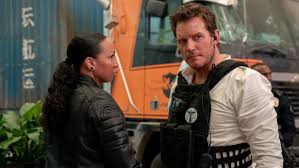 That’s fine, yet there are a couple of big issues the film has to contend with. The first is the screenplay by Marco van Belle. On the surface, he’s written a riff on Minority Report and The Fugitive, only updated to reflect our current anxieties. Dig a little deeper and you’ll see that it’s a script that never gets below the high-gloss facade. Part of the genius of Minority Report is that it grapples with ideas of free will and how much freedom we’ll trade away for “safety.” This script plops its main character into a similar situation**** and never reckons with what the Mercy program really means, or if justice administered by artificial intelligence isn’t a terrible idea. Similarly, a big reason why The Fugitive is an unimpeachable classic is that it squarely puts us in the head and heart of a man who’s been wrongfully accused and is on the run. This script does give its hero some flaws and shading, yet the characters’ actions are always dictated by the plot.
The other issue is with the two talented leads that aren’t utilized as effectively as they could be. A little research tells me that Pratt and Ferguson shot their scenes on separate soundstages and only interacted using earpieces. It was a creative choice in order to show the disconnect between a person and artificial intelligence. I think this was ultimately a bad move. With Ferguson, she’s proven that she’s a deft and intelligent performer. As the coldly logical Judge Maddox, she’s hemmed in and only allowed to play a few notes. It’s not that Ferguson is doing a poor job of acting, it’s that she’s an excellent actor forced to turn in a pretty good performance.
Pratt is just as underserved, but for very different reasons. He’s a solid physical performer, and when he’s in a film like The Magnificent Seven and works with heavy hitters like Denzel Washington and Ethan Hawke, Pratt can keep up. Part of the issue he runs into is that for the vast majority of the film, he’s in a chair not interacting with anyone. Pratt is a good actor, just not a surprising one. I think about Misery, and how Rob Reiner forced the famously energetic James Caan to stay in bed for the majority of his scenes. That drove Caan nuts, and his frustration was the engine of a creative and twitchy performance. I’m not saying Pratt should have done the same thing, only that I wished he could have used his confinement to show us an unexpected side of both the character and himself as an actor.***** Instead, while I somewhat buy Pratt as an alcoholic, he’s mostly playing a standard burned out cop on the edge. Another aspect of The Fugitive that’s so strong is that it takes the normally capable and devil may care Harrison Ford, and makes him scared and desperate. A role like Chris Raven could have been an opportunity for Pratt to flip his persona and force us to reconsider him as an actor.
 I don’t think that the concept of Mercy is an inherently bad one. These days, we’re all scared to death about a potential crime wave, overpolicing, and artificial intelligence that makes things worse rather than better. A film that could weaponize those insecurities would make for a damn fine thriller, one that’s eager to plumb the depths. What we got was a thriller that’s content to skip across the water like a smooth stone.
*It bears asking, in the world this movie takes place in, did the crime rate actually drastically go up? I ask because in 2024, the crime rate fell, and voters still expressed that they were worried about crime.
**I could be wrong, but the movie implies that the Mercy program is only being tested on people charged with murder.
***He produced Searching, a very good thriller set entirely on smartphone and laptop screens.
****Maybe a snap judgment on my part, but wouldn’t the Mercy program be unconstitutional? I think it would violate the Fifth Amendment and the Sixth Amendment. But if the last few years have taught me anything, it’s that a sizable amount of the population would throw away the Constitution in a heartbeat for short-term gain.
*****Considering that Pratt really blew up on Parks and Recreation playing lovable goofball Andy, it feels like an unforced error to cast Jay Jackson in this film as a news anchor, when he played anchor Perd Hapley in Parks and Recreation. It’s like Pratt is trying to get away from being associated with Andy in a project that makes it impossible for me to not think about him.