Peace and Respite
 This article spoils the end of 28 Years Later*
We’ve all seen films featuring human beings that are a) adults and b) presumably not brain damaged yet they behave in extremely brain damaged adult kind of ways. It sucks. It’s maddening. It’s what happens when filmmakers hyperfocus on the plot, so much so that they contort the characters to fit the needs of the plot.
Great filmmakers understand that character should drive plot, as opposed to the other way around. How is that supposed to happen? By showing us the points of view of the characters. When Harry Met Sally, The Silence of the Lambs, Mean Girls, and Leaving Las Vegas are all examples of films where characters influence the plot by their perspectives and their choices.
Now, we have another excellent example of character-forward cinema, and we’ve got it in a horror movie, a genre that is often all plot. 28 Years Later: The Bone Temple does feature considerable gore and terror, but it works so splendidly because it features characters colliding due to who they are.
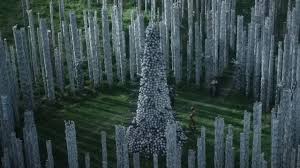
Twelve-year-old Spike (Alfie Williams) has endured horrors and wonders in equal measure. He survived his coming of age ritual with his father, where he left his secure island home and ventured to England’s mainland. He saw those infected by the Rage virus and their devolution into seemingly mindless killing machines. He saw the death of his mother from cancer, and the kindness extended to them by Dr. Kelson (Ralph Fiennes). The good doctor has constructed a mighty pyramid from skulls, as a vast memento mori to the dead.
 Perhaps worst of all for Spike is meeting Sir Lord Jimmy Crystal (Jack O’Connell). He’s the leader of the Jimmys, a band of acrobatic serial killers inspired by Jimmy Savile. Jimmy Crystal gives Spike a choice – either kill one of the other Jimmys and take their place as one of Crystal’s seven “fingers,” or die. It’s wrenching, and Spike makes the first choice. What else can he do? Survive amongst a group of maniacs, though Jimmy Ink (Erin Kellyman) could become an ally.
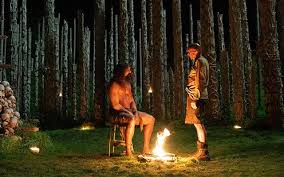
Meanwhile, we return to Dr. Kelson, who has made a curious discovery. Roaming the woods around Kelson’s bone temple is Samson (Chi Lewis-Parry), an Infected who is stronger, tougher, and perhaps slightly more intelligent than the other afflicted. Kelson has devised a morphine-based concoction to stop Samson in his tracks temporarily. He wonders if Samson can be reached, cured, brought back to the person he was twenty-eight years ago. As Samson is in a narcotic haze, Kelson bonds with him.
That’s an exceedingly strange thing for Jimmy Ink to see, a red-hued man speaking to and dancing with a hulking Infected. She reports what she’s seen to Jimmy Crystal, who declares that the red man is Old Nick, A.K.A. Satan, A.K.A. Jimmy Crystal’s father. Did I mention Jimmy Crystal is dangerously insane? He decides to lead his merry band to the bone temple to investigate. And there…
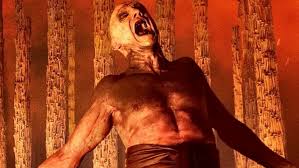
You see that picture up at the top of this article, the one of Ralph Fiennes looking metal as hell? I’m here to tell you that when that particular scene concluded at my screening, there was sustained applause, and I may have been one of the instigators of the applause. Then there was more applause when the film ended. This is because 28 Years Later: The Bone Temple goes insanely hard.
 Director Nia DaCosta does something very tricky and very impressive. She’s made a film that feels like it exists in the same universe as the franchise created by Danny Boyle and Alex Garland, while she also makes this film firmly her own. The previous film acted as a combination of a nightmarish fairy tale and a bleak coming of age story. DaCosta incorporates those elements and adds moments of extreme gore, extreme tenderness, and sequences that simply must be seen to be believed. She does all this in a film that’s under two hours, due to her masterful pacing and tonal control.
Alex Garland returns as screenwriter, and I know, he’s a writer who engenders passionate opinions. When he’s good, he’s good, though. He understands that mainstream audiences want visceral pleasures, and he provides them in spades. However, it’s clear that this story is primarily driven by the choices the characters make and their repercussions. I love that ethos, partially because of how committed Garland is to being truthful toward these people. It also means that, since human beings are inherently unpredictable, the story is just as unpredictable. I had no idea where this thing was going. Anything could happen, and it made for a thrilling experience.
The cast is locked in to the hilt, regardless of their level of screen time. As Spike, Alfie Williams doesn’t appear as much as he did in the prior film. He still makes an impact as a good-hearted boy forced to grow up awfully fast in a place that may be irrevocably broken. He’s got a terrific screen partner in Erin Kellyman as Jimmy Ink. Her eyes tell us that she’s been forced to take part in atrocities, but like most of the other Jimmys, she’s never relished them. I’m a little torn with Jack O’Connell’s performance as Jimmy Crystal. Don’t get me wrong, it’s rocket fueled with madness, humor, sadism, and a sliver of humanity, which makes him an all-timer villain. O’Connell delivered another great antagonist turn last year in Sinners, and were I his manager, I’d advise him to do a rom-com next to avoid being typecast. To my mind, the first among equals in this cast is Ralph Fiennes as Dr. Kelson. We all know he’s a generational talent as a dramatic actor, and Fiennes proves that again. This role is also a reminder that Fiennes can also be deeply funny. There are moments here where he deploys bone dry humor alongside a willingness to be phantasmagorically ridiculous. So much so that he goes all the way past ridiculous and emerges into being awe-inspiring.
 I get it. Maybe you don’t want to take a risk on a theatrical experience. Tickets and concessions are too expensive, audiences are too dumb to be allowed in public, and we’ve all seen movies that feel like they’re constructed by committee. 28 Years Later: The Bone Temple is one hundred percent worth the risk. It’s an outstanding film that functions due to its laser focus on character.
*And you really need to see 28 Years Later, as this film is a direct sequel.