Why Boulder Neighborhoods Can Feel 17 Degrees Cooler

As Boulder wakes up to another scorching summer Sunday, the official temperature tells only part of the story.
Walk or bike across town on a hot afternoon and the difference can be remarkable. One block may feel punishing under direct sun, while another—lined with mature trees and deep shade—can feel like an entirely different environment.
Boulder has the data to prove just how dramatic that difference can be.
In 2022, more than 70 community volunteers spread across Boulder as part of a National Oceanic and Atmospheric Administration Urban Heat Mapping Campaign. Equipped with heat sensors, volunteers traveled through neighborhoods by car, bicycle and on foot during the morning, afternoon and evening on one of the hottest days of the year.
What they discovered was striking.
Temperatures across Boulder varied by as much as 17 degrees Fahrenheit.
According to the City of Boulder, areas with very little vegetation and large amounts of impervious surfaces—including roads, buildings and parking lots—were significantly hotter. NOAA reported that Boulder experienced one of the greatest temperature ranges among cities participating in the national heat-mapping effort.
The cooler areas had something important in common: trees and vegetation.
Boulder’s Natural Air Conditioners
Trees provide one of the simplest forms of natural cooling available to a city.
Their canopies prevent direct sunlight from heating sidewalks, streets, buildings and other hard surfaces. Trees also cool their surroundings through evapotranspiration, the process through which water moves through plants and is released into the atmosphere.
Put those effects together and a mature tree canopy can create a noticeably different microclimate.
Boulder’s heat mapping showed that residential areas with dense tree canopies tended to retain less heat throughout the day. Heavily vegetated areas, including stretches along Boulder Creek, also helped cool surrounding neighborhoods.
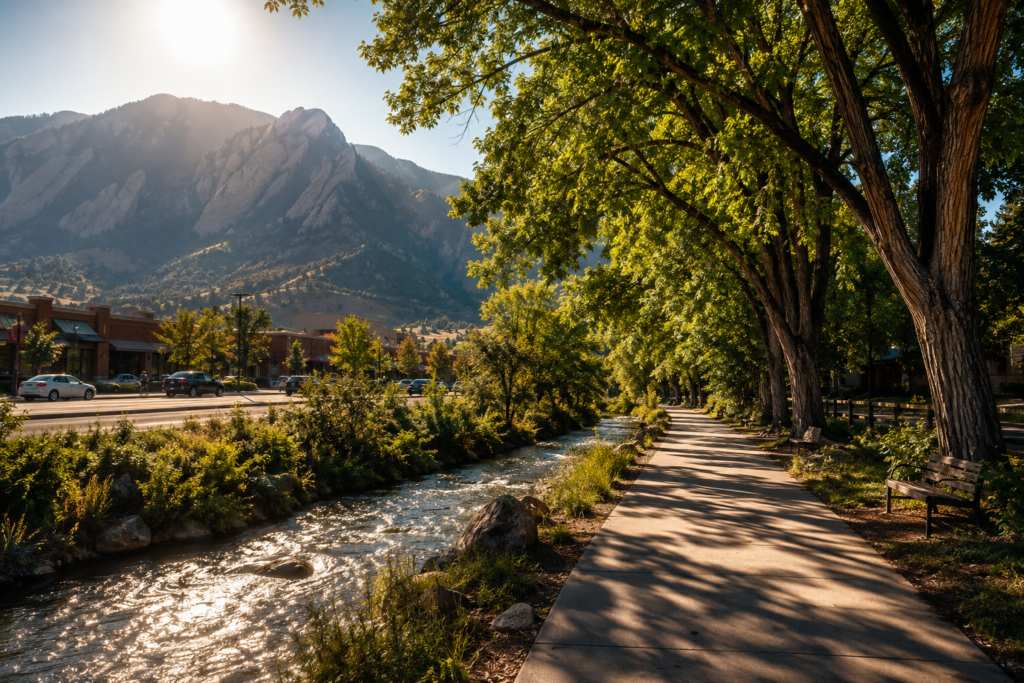
That makes the Boulder Creek corridor more than a beautiful recreational resource during the summer. Its combination of water, vegetation and mature trees helps create one of the city’s important cooling corridors.
Boulder’s Tree Canopy Covers About 22 Percent
Boulder currently has an urban tree canopy of approximately 22 percent, according to the city’s 2025 State of the Urban Forest report.
But the citywide percentage doesn’t tell the whole story.
Tree coverage varies considerably across Boulder. Some neighborhoods enjoy streets lined with mature trees, while other parts of the city have considerably less canopy and greater exposure to extreme heat.
That disparity becomes especially noticeable during stretches of intense summer weather.
A mature tree can provide something a newly planted tree simply cannot deliver immediately: decades of accumulated shade. Young trees are critical to Boulder’s future, but protecting large, established trees is equally important because replacing their cooling capacity takes years.
The Connected Canopies Strategy
Boulder is already working on the issue.
Cool Boulder, a community climate initiative, identifies “Connected Canopies” as one of its major strategies for reducing temperatures and expanding access to the benefits provided by urban trees.
The initiative emphasizes both protecting the existing canopy and planting thousands of additional trees. Importantly, much of Boulder’s potential future tree canopy is located on private property, making homeowners, businesses and property managers part of the solution.
The idea is bigger than planting individual trees.
Connecting shaded streets, yards, parks and green corridors can create a network of cooler spaces throughout the city.
Finding Relief During Boulder’s Heat
With another period of intense heat arriving this weekend, Boulder residents can see the city’s heat map playing out in real time.
An exposed parking lot at mid-afternoon can feel brutal. Walk several blocks into an older neighborhood beneath mature trees and conditions can change dramatically. Head toward a heavily shaded portion of the Boulder Creek Path and the contrast can become even more noticeable.

Common-sense heat precautions remain essential: stay hydrated, reduce strenuous activity during the hottest part of the afternoon and check on neighbors who may not have adequate cooling.
But Boulder also has thousands of natural air conditioners already operating.
They line older streets, shade backyards, tower over parks and follow Boulder Creek.
The city’s heat-mapping project put a number on something Boulder residents have experienced for years: where you stand during a heat wave matters.
When temperatures soar, shade isn’t simply comfortable.
It is part of Boulder’s climate infrastructure.
And the trees quietly providing it may become increasingly valuable with every hot Colorado summer ahead.