Our Stories
A couple weeks ago, I found myself wandering down Santa Fe, moving slowly, almost aimlessly, pulled along by color, by texture, by the quiet invitation of gallery windows.
I stepped into El Museo de las Americas: a bright pink building that felt warm before I even crossed the threshold. Inside was Nuestras Historias (“Our Stories”), an exhibit I entered because of a friend’s recommendation and left carrying something much heavier, and much more hopeful.
It’s difficult to describe the exhibit in simple terms, because it isn’t just one thing. It is video and embroidery, poetry and ceramics, fragments of identity stitched and painted and spoken into being. It is laughter and grief sitting side by side. It is young people telling the truth.
Nuestras Historias brings together teens from Museo’s Lxs Jovenes Leadership Lab and professional artists in a collaboration that feels less like instruction and more like conversation: one that stretches across generations, across lived experiences, across ways of seeing the world. Themes of tradition, justice, identity, and playfulness echo throughout the space, but what lingers is something deeper: a kind of honesty that cannot be manufactured.
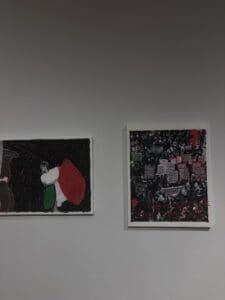 I moved through the exhibit slowly, aware of my own body in a way I hadn’t expected: goosebumps rising, breath catching, the quiet instinct to pause and really look. There is something disarming about witnessing young people when they are not filtered, not rushed, not asked to make themselves smaller. When they are given space, real space, to create, what emerges is not just art, but truth.
Through my work with Dream Tank, I have spent a lot of time thinking about collaboration, what it means, who it includes, and what it makes possible. And what struck me most about Nuestras Historias is how fully it embodies something Dream Tank believes at its core: that intergenerational collaboration is not a bonus, but a necessity.
Here, young artists are not positioned as future creators, they are creators now. They are not spoken for; they are listened to. Under the guidance of professional artists, they are invited into every part of the process: not just making the work, but shaping how it is seen, how it is held, how it lives in the world. The result is something that feels alive, because it is built together.
And in that shared process, something else happens.
As a young person, I have been lucky to be mentored by people like Heidi Cuppari, Laura Weinberg, and Rebecca Irby: people who did not just offer advice, but offered attention. The kind of attention that says: I hear you. Keep going. It is a subtle but profound shift, from being told what is possible to being trusted to imagine it yourself.
That kind of mentorship doesn’t just build skills, it builds belief. It leaves you with the quiet but steady understanding that your voice matters, that your ideas have weight, that you are not creating alone.
But what Nuestras Historias makes clear, beautifully, and almost tenderly, is that this exchange is never one-sided.
Many of the professional artists reflected on how working alongside youth reshaped their own creative practices. How the openness, urgency, and imagination that young people bring can cut through fatigue, through routine, through the slow drift into certainty. There is a kind of courage in youth expression, a willingness to say what is hard, to imagine what does not yet exist, that invites others back into their own curiosity.
In that way, collaboration becomes something reciprocal. Not teaching, not guiding, but meeting. A shared act of making meaning.
And maybe that is why the exhibit feels so moving, because it offers a glimpse of something we are, collectively, a little starved for.
In a world that often feels fractured, fast, and impossibly loud, Nuestras Historias insists on something quieter: that listening matters. That creation can be communal. That wisdom does not belong to one generation, but lives in the space between us.
I left the museum thinking not only about the art itself, but about the conditions that made it possible. About what it would look like if more spaces operated this way, if we trusted young people not just to participate, but to lead. If we saw mentorship not as direction, but as relationship. If we understood collaboration not as efficiency, but as care.
In Golden, Colorado, Dream Tank’s Systems Change L.A.B. is bringing together young people, high school interns, university fellows, and community mentors to design real solutions to real challenges, and then carry those ideas back into the places they call home. The LAB will build on the same spirit that moved me through that pink-walled museum: the belief that young people are not waiting to lead, that the art they make and the ideas they hold and the futures they can imagine are needed right now, not later.
And in this moment, this complicated, beautiful, overwhelming moment, that feels not just inspiring, but necessary.