The Health & Fitness Trends That Defined Boulder in 2025

In 2025, Boulder didn’t chase fitness trends—it refined them. While much of the country cycled through workout crazes and high-intensity fads, Boulder leaned into something quieter, more sustainable, and deeply rooted in how people actually want to live. The year marked a clear shift away from performative fitness and toward long-term health, daily movement, and recovery-driven wellness. It wasn’t about doing more. It was about doing better.
Three trends stood out above the rest: a renewed walking culture, outdoor fitness replacing indoor workouts, and a growing focus on longevity, mobility, and recovery. Together, they reshaped what “being fit” looked like in Boulder.
Walking Culture Over Gym Culture
One of the most noticeable shifts in 2025 was the rise of walking as a primary form of fitness. In Boulder, walking stopped being seen as a warm-up or an afterthought and became the workout itself. Daily walks along Boulder Creek, neighborhood loops, campus strolls, and evening walks through open space became part of people’s routines—not as a substitute for exercise, but as the foundation of it.

This wasn’t accidental. People began prioritizing consistency over intensity. Walking fit into real life. It supported mental health, reduced stress, improved cardiovascular health, and didn’t require scheduling, memberships, or recovery days. In a town already built for walkability, Boulder residents leaned all the way in.
Gyms didn’t disappear, but they stopped being the centerpiece. Movement became something you did throughout the day rather than something confined to an hour-long block indoors. Walking meetings, morning walks, and post-dinner strolls became normalized. Fitness blended seamlessly into daily life, which is exactly why it stuck.
Outdoor Fitness Took the Lead
If there was one defining Boulder trait in 2025, it was this: people chose fresh air over fluorescent lights. Outdoor fitness officially surpassed indoor workouts as the preferred way to move. Hiking, trail running, cycling, climbing, yoga in parks, bodyweight workouts at trailheads, and open-space strength sessions all became more popular than traditional gym routines.
The Flatirons, foothills, and surrounding open spaces weren’t just scenic backdrops—they became the gym. Boulder residents recognized that moving outdoors delivered more than physical benefits. It improved mood, reduced anxiety, and reinforced the deep connection between health and nature.
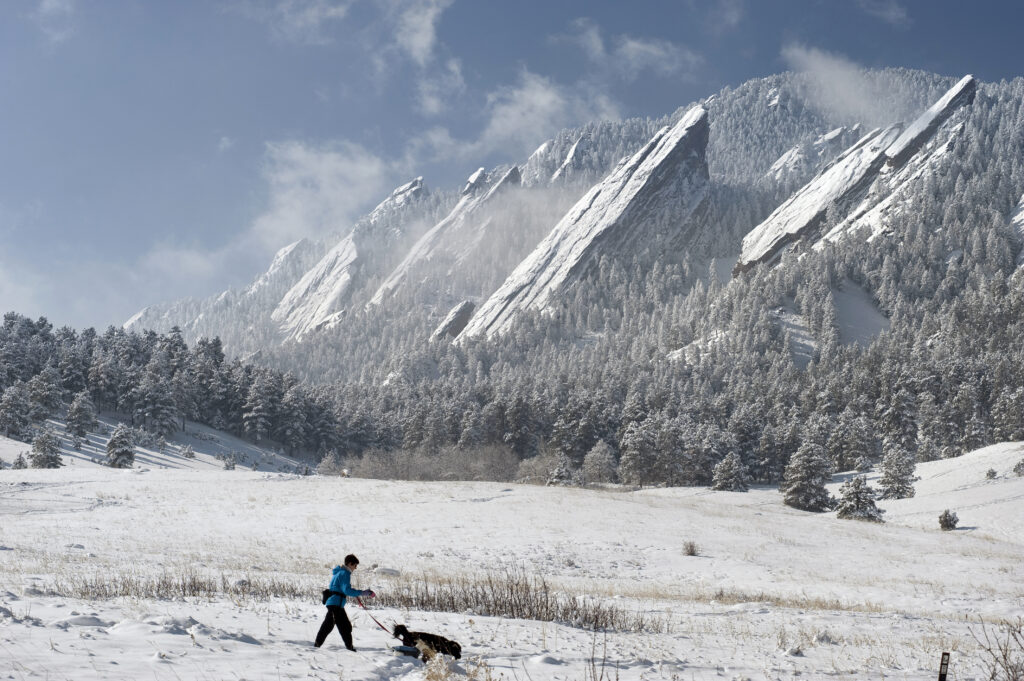
A winter storm clearing with the Flatirons pictured in Boulder, Colorado taken from Baseline Road near Chautauqua Park with a woman hiker walking her dog.
Weather was no longer an excuse. People adapted instead. Layering, timing workouts around sunlight, and embracing seasonal shifts became part of the fitness mindset. The outdoors offered variety, challenge, and meaning that no treadmill could replicate.
This shift also changed how people defined progress. Instead of tracking reps or mirror results, progress looked like longer hikes, stronger climbs, steadier breathing on ascents, and feeling energized rather than depleted.
Longevity, Mobility, and Recovery Took Center Stage
Perhaps the most important trend of all in 2025 was the growing emphasis on longevity. Boulder residents began asking better questions: How do I want to feel in ten years? How do I stay mobile, pain-free, and active for life?
Mobility training, joint health, balance work, and recovery became just as important as strength and cardio. People invested time in stretching, breathwork, massage, and low-impact movement. Recovery stopped being something you earned after hard workouts and became a proactive practice.
This mindset reflected maturity. Boulder’s health culture moved away from burnout and toward sustainability. The goal wasn’t peak performance for a season—it was feeling good year-round, decade after decade.
Sleep, nutrition, nervous system regulation, and stress management were no longer fringe topics. They were central to the conversation. Fitness became holistic, intentional, and deeply personal.
A Boulder-Specific Way Forward
What made these trends uniquely Boulder wasn’t just the activities themselves—it was the philosophy behind them. Health in 2025 became less about proving something and more about protecting something: energy, clarity, mobility, and joy.
Boulder showed that fitness doesn’t need to be loud, extreme, or exhausting to be effective. Sometimes the most powerful changes come from slowing down, stepping outside, and choosing movement that fits your life instead of fighting it.
As 2026 approaches, these trends aren’t fading. They’re becoming the standard. And in true Boulder fashion, they feel less like trends and more like a return to what health was always meant to be.