When Color Became the Point

In Boulder, winter has a particular kind of light: bright enough to make you feel hopeful, sharp enough to make you feel honest.
That was the container I was in during Dream Tank’s two-week Systems Change Lab, where a cohort of Brown University students and a circle of mentors convened to prototype a toolkit cities could actually use to guide systems change.
The sprint built toward DREAMCAST, a live broadcast where we shared what we learned and what we were daring to try next: youth vision moving toward collective action.
One of our goals was to bring this work directly to city leadership in Boulder and Providence, an opportunity made possible through the visionary support of Mayor Laura Weinberg of Golden, Colorado.
As a fellow Brown alumna, Weinberg reconnected with Dream Tank founder Heidi Cuppari at their Class of ’95 reunion last May, and a shared question quickly became a plan: what would it look like to build a youth program beyond the limits of traditional city youth councils? Together, they helped shape a three-city pilot and the Systems Change Lab model.
With Weinberg’s help, our team pitched our Systems Lab work to Mayor Aaron Brockett of Boulder and Mayor Brett Smiley of Providence.
The Problem of Translation
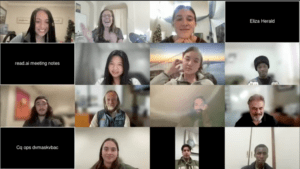
The day before one of our first mayor meetings, we were on Zoom building the deck together: fast, collaborative, a little chaotic. Nine squares of faces. A shared screen. The cursor blinking impatiently. We were doing real work, translating human problems into something a city could use: a pathway, a next step that wouldn’t evaporate the moment the meeting ended.
But the moment that stuck with me most wasn’t the pitch. It was the debate that erupted mid-build: Do we fill our slides with color and whimsy, the visual language that actually matches the way we dream? Or do we flatten everything into the clean, muted look we’ve been trained to call professional?
Underneath the debate was the real question: will we be taken seriously if we stay ourselves?
There we were, a group of young, passionate students working to change the world, and still we worried about credibility. It wasn’t an aesthetic debate. It was a translation problem: how much brightness is “allowed” before someone dismisses the work as naïve? How much softness can exist before it becomes a risk?
In the middle of the slide chaos, our mentor and partner Rebecca Irby, Founder and President of the PEAC Institute, and an educator and peacebuilder working at the intersection of empathy, youth leadership, and high-stakes advocacy, asked us to pause.
She named what we were all feeling: that subtle pull to shrink, to mute the color, to make ourselves legible to systems that reward sameness.
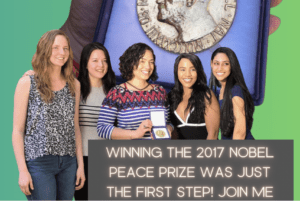
She admitted she’s felt it too. Early in her career, Rebecca chose a path that didn’t come with the usual signals of ‘socially-understood’ legitimacy: using narrative, art, and relational intelligence to take on nuclear disarmament and peacebuilding. People told her she was crazy. They said empathy had nothing to do with disarmament, that storytelling couldn’t stand up in rooms where the stakes were measured in policy and weapons. She felt the pressure to pick a path that was easier to defend, something that sounded more “official,” something that wouldn’t require constant explaining.
But she did it anyway. And because she did, her work exists: research that holds weight, stories that change what people believe is possible, relationships strong enough to carry hard conversations. Proof that the abilities we dismiss as “soft,” the ability to build trust, shift meaning, and move human attention, can change the hardest systems, piece by piece, into something more livable. Rebecca didn’t contort herself into what others deemed impressive. She chose what was true.
That moment, Rebecca naming our hesitation, was proof of something Heidi Cuppari has been building Dream Tank around from the start. Youth haven’t fully adopted the norms and standards of professional society. They haven’t had their dreams crushed by people telling them their vision was silly or impossible or idealistic.
Youth bring childlike wonder and untouched genius to systems work. They lead by example and help intergenerational teams remember their spark. That authenticity is exactly what Dream Tank was designed to protect and amplify. Our slide debate only proved the point: already, young people feel the pressure to flatten themselves. The question is whether we let that pressure win.
Bravery as practice
Rebecca then gave our slide debate its real name: codeswitching. Most people treat codeswitching like a personal tactic, shifting your voice, your posture, your language depending on the room. But in the United States, it carries a history shaped by race, language, and survival, because institutions have long treated one way of being as “standard” and everything else as something you have to translate. That’s why I want to be careful here: what we were doing on Zoom isn’t the same as what Black Americans, and other marginalized people, have been forced to do for safety. But it can come from the same architecture: dominant norms labeled “professional” and “proper,” everyone else quietly pressured to flatten themselves to be taken seriously.
Our slide debate named an emotional risk that rarely gets spoken aloud in civic innovation conversations. It’s not just the intellectual risk of a pilot failing. It’s the social risk of being dismissed. The internal risk of learning to treat your own softness as a liability.
That’s when it clicked for me: bravery isn’t a personality trait. It’s a practice. Not the loud kind of courage, the quieter kind, the kind that keeps choosing what’s true even when the world calls it irrational.
We like to pretend the barrier to systems change is intelligence, that if we had better frameworks, better data, better models, we’d be fine. But so often the real barrier is fear. Fear of looking naïve. Fear of being called “cute” or “idealistic.” Fear of trying something visibly different. Fear of color. Fear of caring out loud.
And yet, people are hungry for the very things we’ve been trained to edit out: honesty, warmth, leadership that doesn’t sound like a template. Solutions that feel human- centered. So I return to Rebecca’s story, and to Boulder’s winter light: bravery as a systems practice.
The courage to choose what you believe in even when the world calls it irrational. The courage to build futures that actually look like futures: bright, strange, tender, unapproved.
If you have to abandon your humanity in order to be taken seriously, what exactly are you changing the system for?
There is courage in choosing not to contort yourself to power. That’s quiet. That’s generous.
That’s Boulder, at its best.