Bullet Time
 For better or worse, America is a gun culture. So much so that, to some degree or another, we all come into contact with them. I don’t own a gun, but I have fired them.* I’ve also had them pointed at me a few times, which is an experience I don’t recommend. I spent a number of years working in Wilton, Connecticut, which is a little bit South of Newtown. My son was only a year younger than those first graders in that classroom, a coincidence I’ve dwelled on.
It’s estimated that there are somewhere in the neighborhood of 400 to 500 million privately owned firearms in America. Is that too many? Maybe, but I think about the soft spoken neighbor I had who went hunting a few times yearly and generously gave me the best venison I’ve ever had. I think about the woman I went to college with, who was living alone when a man consumed by a mental health episode tried to force his way into her home. She was understandably terrified, and immediately bought a pistol. I haven’t spoken to her in years, but I imagine she still owns her gun.
It’s all hideously complex, but you wouldn’t think so by watching the majority of American movies. Guns act as the great equalizer, and they’re used by everyone from a killing machine like John Wick to a blue collar underdog like John McClane. Once in a while, though, a movie is made that tries to get its arms around guns in America. That’s what the new indie drama Ballistic does. It bites off a little more than it can chew, but I have big respect for the effort.
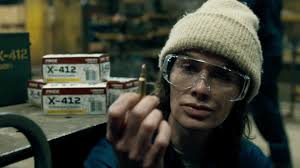
 We meet Nance (Lena Headey), a woman who works in a munitions factory. Her husband died years ago, and she largely raised her son Jesse (Jordan Kronis) alone. Nance helps Jesse shave his head in preparation for joining the Army. We don’t know if he joins because of duty or patriotism, but we do know he joins to help care for his pregnant girlfriend Diana (Amybeth McNulty). The benefits given to service members and their families are too small, but Nance tells Diana not to worry. She’ll have a home with Nance, and that’s one less thing for Jesse to worry about as he’s sent to Afghanistan.
During a Zoom call, Jesse tells Nance that he’s worried, that people stateside don’t understand what’s happening there or what’s being asked of the troops. He’s right, Nance doesn’t understand. She only wants to comfort her boy, and she tells him he’s safe. But when Nance comes home from work and sees Galindo (Amanda Brugel), a uniformed Casualty Notification Officer, quietly waiting on her front porch, she knows the truth.
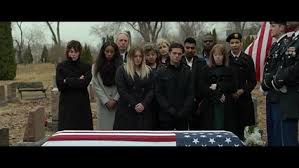
Nance’s world falls apart. As she sees her son in his casket, and as he wears a slight smile suggesting he’s learned something the rest of us aren’t ready for, she begins to harden. Diana is now in the same position Nance was, and she begs Nance for help. Kahlil (Hamza Haq), a military grief counselor and former Afghan interpreter, offers her a similar perspective and a receptive ear. Over and over, doors open for Nance that lead to some kind of healing. She passes them by. Her grief is a wild thing.
Nance explodes when she discovers the round that struck down Jesse was manufactured in her factory. Someone has to pay. But who? Should it be Rick (Enrico Colantoni), a manager at her factory who acknowledges that the very ammunition they make is sometimes sold to the Taliban on the black market? Or Buchanan (Chad Faust), the Army recruiter who recruited Jesse? Or Kahlil himself, a man who lived among those who killed her son? In the midst of a vast military industrial complex, someone has to pay.
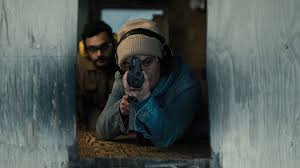
 When I first heard about Ballistic, I worried that it would be a dumb as toast, borderline racist revenge movie. Instead, director Chad Faust made a film of great power and greater nuance. For a movie that’s all about guns, I liked that Faust never portrays them as either mega-awesome patriotism symbols or nightmarish harbingers of doom. If you’ll pardon the somewhat tasteless pun, Faust shoots them neutrally. They’re tools, wielded by the responsible, the foolish, the stable, and the damaged. The film is shot naturally, and set in lower middle-class homes, apartments, and workspaces. The attention to detail is superb. I recognized homes like this. I’ve even lived in a few of them. I’d ordinarily be thrilled that a film is a fleet ninety minutes, but in the case of this film, the pacing sometimes feels a little too fast. Still, Faust knows when to pump the brakes and give us time to sit in Nance’s headspace.
Faust wrote the screenplay, and considering he’s written a thoughtful examination of how firearms affect Americans at home and abroad, he’ll probably end up pissing off most of the country. Good for him. He’s learned the lesson that the best way to tackle a massive subject is to zoom in and make it as specific as possible. It’s true there are a few small montages where we see a crate made by Nance end up in Kabul. For the most part, the script sticks with Nance’s POV and we see her marinate in a stew of conspiracy theories, as she tries desperately to cast blame. It’s the fault of the man who shot Jesse, the U.S. Army, her company, her manager, Kahlil, and herself. The script also posits that the Afghan war was largely a waste of time that accomplished very little,** and we get the sense that things will have spiraled out of control by the time Nance understands that.
I’d like to think that come awards season, Lena Headey will have some accolades thrown her way. She likely won’t due to this film flying under the radar, and a performance that bravely flirts with unlikability. Headey doesn’t play Nance as someone who’s gullible, evil, or a racist. Instead, the bottom drops out of her life upon the death of Jesse. We watch her move through the links of the military industrial complex and make, then reconsider targets. On top of that are moments when Nance receives off ramps and refuses to take them. Sometimes grief overtakes rationality. Headey understands that, and her performance is painfully human.
The supporting cast is excellent, and two actors deserve particular focus. The first is Hamza Haq as Kahlil, and his performance is wonderfully complex. Watch the quiet compassion as Kahlil tries to connect with Nance, as he tells her about the death of his young son, and how he traded his son for a life in America. It’s shattering, and Haq performs with exquisite control. Equally strong is the one scene performance by Chad Faust as the recruiter Buchanan. Nance accuses him of selling her son a lie. He responds without raising his voice, and tells her why he’s a recruiter and what it’s cost him.
 There’s nothing wrong with watching an action movie featuring gun violence. Shakespeare featured swordplay, Mary Shelley featured a stitched-together golem ruining a wedding night. Larry McMurtry featured widespread brutality through the Old West. The precedent exists, and pooh-poohing the appearance of guns in film is largely a waste of time. Yet sometimes a movie comes along that examines the many ways that firearms fit into our society and affect our world. Ballistic is one of those films, and it deserves to be seen and considered.
*For one of our first dates, my wife & I went to a shooting range. I am, um, not a great shot! She, on the other hand, got the hang of it disturbingly quickly.
**Much like a certain war in Iran I could mention.