It’s Hard to Dream, Think, or Build New Systems if You Haven’t Healed
Dream Tank’s Systems Change Lab was supposed to be a build sprint: practical tools, real-world testing, something a city could hold in its hands.
Then the tragic events of December 13th happened at Brown University, and the project became deeply relevant.
Heidi Cuppari, Dream Tank’s founder and a Brown alumna, responded the way she often does: with presence, optimism, and an insistence that care is part of the work. She helped our group name what we needed next, which wasn’t another framework. It was fluency in trauma as biology: how stress reshapes the brain, interrupts memory, and narrows the very capacities communities rely on, including learning, judgment, and even humor.
With Heidi’s help, we learned directly from Kevin Braney, Ph.D., also a classmate at Brown;
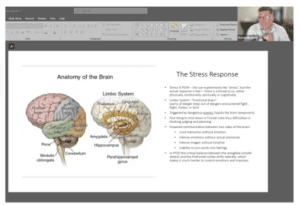 a crisis-response leader who has spent years helping schools and communities navigate rupture and find their way back to steady ground. Kevin served as Principal of Boulder High School and supported local trauma-response efforts in the aftermath of the King Soopers shooting in 2021. Today, he serves as Director of Safety at the Colorado Coalition for the Homeless, where his work continues to sit at the intersection of crisis response, prevention, and human-centered systems of care.
We didn’t bring Kevin in just forinspiration. We also brought him in for accuracy. If we were going to build anything useful, we had to understand trauma as biology: what stress does to attention, memory, and meaning, and why “just move on” can backfire.
Part of our session was also an introduction to Psychological First Aid: a grounded, practical approach used in the aftermath of crisis to help people stabilize, reconnect, and regain a sense of choice.
People Can’t Think, Build, or Dream if They Haven’t Healed
Later that afternoon, I went back to my normal life, which meant scrolling. Funny cat videos. Mountain bike clips. A little relief, a little distraction.
And then, without warning, videos of U.S. citizens being murdered on city streets.
My mind didn’t choose to take that in, but my body did anyway. My chest tightened. My shoulders lifted. My nervous system reacted before I could decide what I believed, what I wanted to do, orhow much I could handle.
I think it’s important to name the paradox, because it matters. The internet is also where we find the stories that wake us up. The footage we see, the testimony people share, the courage captured in real time, it can move us toward empathy, toward action, toward each other. It helps us care beyond the borders of our own lives.
But care without tools can turn into harm. You can’t keep asking your brain to witness the unbearable and expect it to stay wise.
Kevin gave us language for what happens to someone’s brain in those moments. Under extreme stress, the part of the brain that makes us reflective and relational goes quiet. He calls it the “wizard brain,” the part that holds speech, nuance, sarcasm, facial expression, and long-term thinking.
When danger hits, the “lizard brain” takes over. It runs on survival. It scans for threats. It narrows your whole world to the right now.
In the lizard brain, it becomes harder to learn. Harder to remember. Harder to study. Harder to imagine a future.
Kevin also explained that stress is contagious. Trauma ripples outward. Even people who weren’t present at a traumatic event can feel it in their bodies, because bodies learn fear faster than minds can narrate safety.
After doomscrolling, I don’t just feel sad. I feel rattled. And strangely purposeless.
Agency as First Aid
One of my biggest takeaways from Kevin’s session was simple:
Agency matters.
Agency is not a motivational add-on. It’s what keeps grief from collapsing into helplessness. It gives the nervous system a direction: a place to put what hurts, so it doesn’t only turn inward.
Kevin rooted this idea in principles from disaster psychology, simple on purpose, because when stress is high, complexity disappears:
- Safety
- Calm
- Belonging and connection
- Efficacy: ownership and choice
- Efficacy at the system level: institutions that respond without taking over
The throughline is choice. Healing can’t be imposed. When systems force a return to “normal,” some people feel erased and re-wounded. Others need routine immediately to stay afloat. The only humane approach is to design tools for both: multiple doors, different paces, and room to decide.
It left me with a question I couldn’t shake:
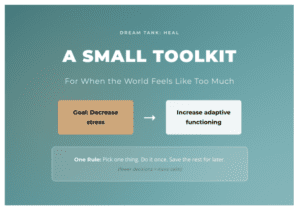
What if I had a small, accessible toolkit that held both sides of the equation… ways to steady my body when it’s activated, and ways to reclaim agency when the world makes me feel purposeless?
A Healing Toolkit (for when the world feels like too much)
Dream Tank is putting the full toolkit on our website because these are the kinds oftools you need within reach, not buried in a paragraph you have to re-find.
It’s a small menu for when the world feels like too much: how to come back into your body, how to reconnect, how to choose one true step.
Save it. Share it. Return to it.
And if you have resources we should add, especially culturally specific supports, we want your input. This toolkit is meant to stay alive.
Access the Healing Toolkit here
Kevin said something that stuck with me because it explains why institutional “help” sometimes makes things worse:
When people swoop in with solutions without relationships, cultural awareness, or listening, they can accidentally cue survivors right back into powerlessness.
That’s why his model is not “do more.” It builds choice and connection in the same place. Let people enter at their own pace. Let them take what they need and leave the rest. Design the environment so the wizard brain can come back online.
He offered a concrete example. After the King Soopers shooting, the work wasn’t always therapy in the abstract. Sometimes it was simply accompanying someone into the grocery store—not to shop, not to perform normalcy, but to gently re-enter the space with support.
Healing is messy. It isn’t linear. And it requires humility from leaders who want things controlled.
Here’s what I want to say plainly, because I think many of us are living it:
If your nervous system is overwhelmed, it is not because you are weak. It is because you are human in a world that keeps asking you to witness the unbearable.
But you are not meant to carry everything you see.
You are meant to come back into your body and reclaim one true, concrete action that reminds you you’re not powerless—even if that action is washing your face.
Kevin gave us the line I’ll keep returning to: decrease stress to increase adaptive functioning. That’s not just a public health idea. It’s a survival strategy for this generation.
So if the feed gets violent, don’t try to “be strong” in a lonely way. Don’t punish yourself for being affected. Do the smaller, braver thing:
Put your feet on the floor.
Exhale longer than you inhale.
Text one person.
Choose one door.
Walk through it.
Little by little.
And in community with others taking positive right action toward thriving.
That is how we keep our wizard brains.
That is how we keep our humanity.
That is how we build what comes next.
Access our Healing Toolkit + Join Us here