
Boulder’s Bee Legacy: From Historic Honey Production to 552 Native Bee Species
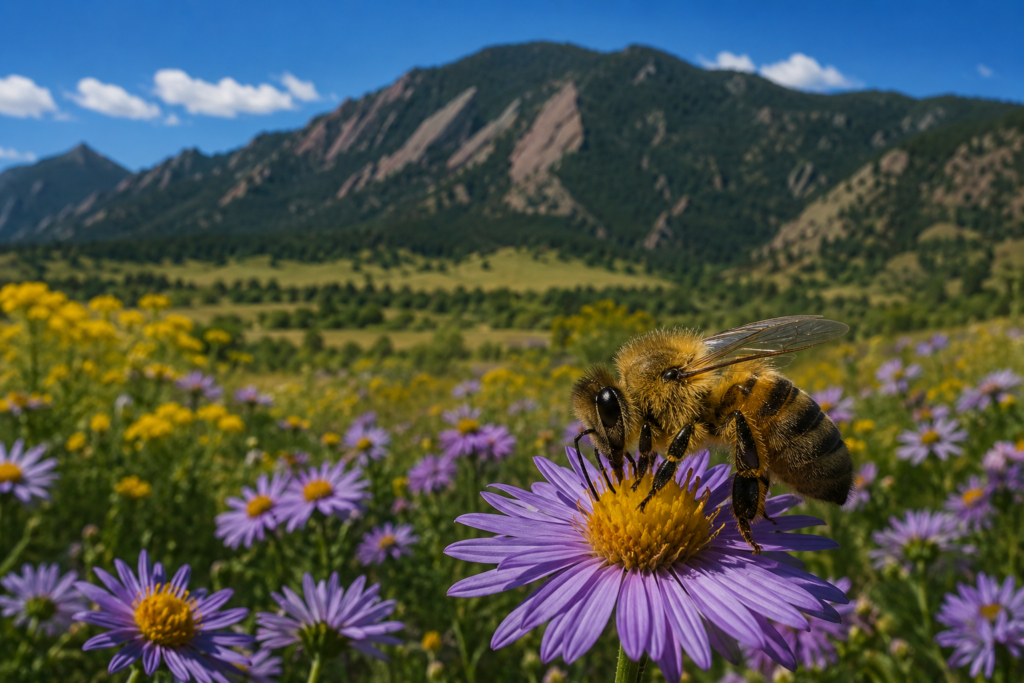
Boulder County has a bee story unlike almost anywhere else in Colorado.
More than a century ago, the region was known for commercial honey production and a growing network of serious beekeepers. Today, Boulder County is equally remarkable for something very different: an extraordinary diversity of wild bees.
From the agricultural fields of the eastern plains to ponderosa pine forests and high alpine tundra, Boulder County’s dramatic landscape supports one of Colorado’s richest documented bee communities. It is a story that connects agriculture, scientific discovery, environmental change, and a local culture that continues to care deeply about pollinators.
Boulder’s Early Beekeeping Boom
Beekeeping became an important part of agriculture along Colorado’s northern Front Range during the late 19th and early 20th centuries. The region’s irrigated farms, alfalfa fields, orchards, and flowering plants created productive conditions for honeybees.
Historical accounts describe a thriving honey industry across communities including Boulder, Longmont, Loveland, Fort Collins, and Berthoud. Honey production was more than a backyard pastime. For some families and agricultural operations, bees were part of a serious regional economy.
The early history of Boulder County beekeeping is also associated with pioneer David Lykins, one of the county’s early settlers. Local historical accounts credit Lykins with becoming one of the area’s first beekeepers after receiving honeybee colonies from relatives in the eastern United States.
By the beginning of the 20th century, bees had become both an agricultural resource and a subject of serious scientific interest in Boulder.
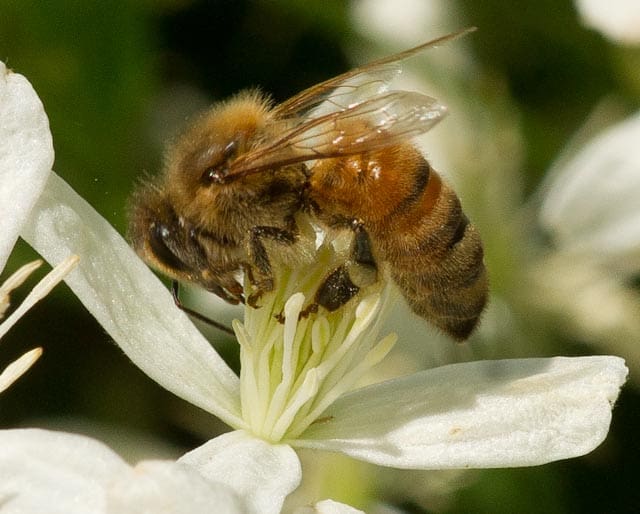
A bee doing it’s most important pollinating work. A macro lens can be GREAT fun! Photo: Lenny “Lensworth” Frieling
The Scientist Who Put Boulder’s Bees on the Map
In 1907, University of Colorado scientist Theodore D.A. Cockerell published The Bees of Boulder County, Colorado, one of the foundational studies of the region’s bee life.
Cockerell’s list included 183 species — a remarkable total for such an early survey. His work helped establish a scientific record that later researchers could build upon and compare with modern collections.
More than a century later, that research tradition continues.
A major Colorado bee survey published through the CU Museum of Natural History documented 552 bee species in Boulder County, the highest recorded county total in Colorado at the time of the study.
That figure is especially impressive considering that Colorado is now known to support more than 1,000 native bee species.
There is an important scientific qualification: Boulder County has been studied intensively for generations, and researchers acknowledge that its high documented total reflects both genuine biological diversity and an unusually long history of collecting and research.
Still, the geography is exceptional.
Boulder County rises across an elevation range of more than 9,000 feet, creating grasslands, foothills, forests, subalpine environments, and alpine tundra within a relatively compact area. That diversity of habitats — combined with an extraordinary variety of flowering plants — creates opportunities for an equally remarkable range of pollinators.

Honey Bee & Gray Nickerbean
Honeybees and Native Bees Are Different Stories
One of the most important distinctions in Boulder’s bee story is the difference between the European honeybee and Colorado’s native bees.
Honeybees live in large social colonies and are managed for honey production and agricultural pollination. Most native bee species live very different lives. Many are solitary, with individual females building nests in soil, hollow stems, cavities, or wood.
Bumblebees are among the most familiar native bees, but Colorado’s bee diversity also includes mason bees, leafcutter bees, mining bees, sweat bees, and many highly specialized species.
This distinction matters because challenges affecting managed honeybee colonies do not always affect native bee populations in the same way.
The arrival and spread of the parasitic Varroa destructor mite transformed North American beekeeping beginning in the late 1980s. The mites weaken honeybees and transmit viruses, forcing modern beekeepers to pay close attention to colony health and mite management.
The result is a very different beekeeping world from the one Boulder County’s early honey producers knew.
Why Boulder Remains Exceptional for Bees
Boulder County’s protected landscapes provide a remarkable range of habitat for pollinators.
Native bees can find nesting opportunities in bare ground, standing plant stems, woody debris, and natural cavities. Diverse flowering plants provide pollen and nectar at different times throughout the growing season.
The county’s grasslands, foothills, forests, and alpine ecosystems support different bee communities, making the landscape valuable not simply because of its size, but because of its ecological variety.
Preserving that variety is essential. Supporting native flowering plants, reducing unnecessary pesticide use, and leaving appropriate nesting habitat can all help local pollinators.

Bee with Pollen. pic Lenny Lensworth Frieling
A Community Tradition Still Going Strong
The Boulder County Beekeepers Association continues the county’s long connection with bees. The organization promotes responsible beekeeping through education, public service, mentoring, and community events.
The association also helps connect residents who encounter honeybee swarms with experienced beekeepers who may be able to collect and rehome them.
That combination of science, education, agriculture, and community involvement makes Boulder County’s bee story especially compelling.
A Bee Legacy Worth Protecting
Boulder County’s relationship with bees has changed dramatically over the past century.
The region once became known for its productive honey industry. Then scientists began documenting an astonishing world of native bee diversity stretching from the plains to the Continental Divide.
Today, those two histories exist side by side.
Backyard beekeepers care for honeybee colonies. Scientists continue studying native pollinators. Open spaces preserve critical habitat. Gardeners plant flowers that provide food throughout the growing season.
The next time you see a bee working a wildflower near Boulder, look closely. It may not be a honeybee at all.
It could be one of hundreds of species that make Boulder County one of Colorado’s most remarkable places for bee diversity — part of a buzzing natural legacy more than a century in the making.